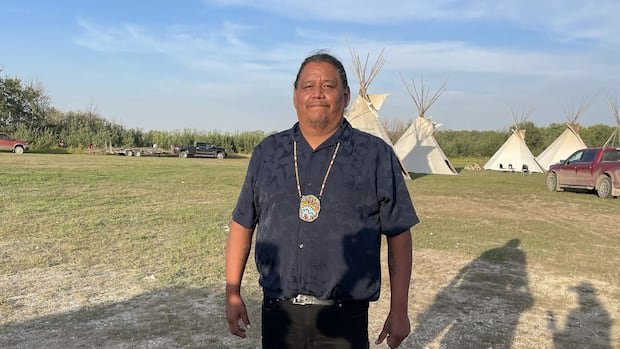


An emotional event unfolded at Kawacatoose First Nation on Friday, as a stolen teepee cover was finally returned after being absent for a century. The community, located about 135 kilometers northeast of Regina, witnessed tears of joy as the teepee cover was unpacked and raised for a ceremonial event led by community members in traditional attire, accompanied by drumming and singing.
Kawacatoose Chief Cory (Okimow) Dustyhorn expressed the significance of the return, stating, “It means a lot to us.” The teepee cover, meticulously crafted by Cory’s great-great-grandfather Sîpiskwêsîkan, also known as Dustyhorn, had not been seen by family members since 1926. Recently, it was discovered that the teepee cover was part of the Smithsonian collection in Washington, D.C.
In a remarkable journey, Cory, accompanied by some family members and Indigenous studies professor Andrew Miller from the First Nations University of Canada, made a 29-hour drive south to retrieve the treasured artifact from the National Museum of the American Indian. The emotional impact of witnessing the teepee cover returned to its place of creation was deeply felt by Yolanda Dustyhorn, another descendant of Sîpiskwêsîkan.
Following the retrieval of the teepee cover from the Smithsonian, the group embarked on the long journey back home, with the Kawacatoose community eagerly awaiting the artifact’s return. Referred to as “moshum,” meaning grandfather in Cree, the teepee cover symbolizes the return of the stolen heritage to its rightful owners after a century of absence.
The teepee cover, representing a connection to ceremonial practices that were once criminalized and the subsequent loss of cultural identity, will remain in Kawacatoose for four days before being transferred to the Royal Saskatchewan Museum in Regina for further preservation and display.