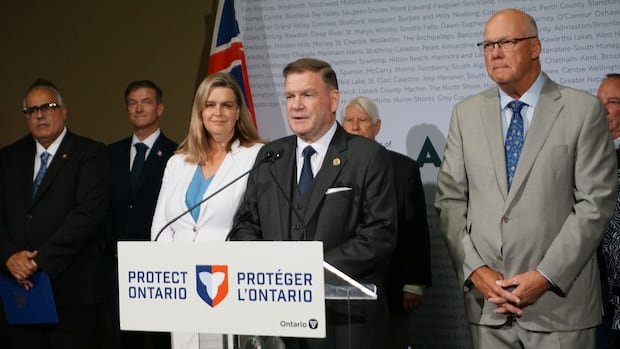


The Ontario and Canadian governments have allocated $1 billion to assist municipalities that do not impose development charges in constructing and upgrading critical infrastructure. This initiative was announced at the Association of Municipalities of Ontario (AMO) conference in Ottawa by Todd McCarthy, Ontario’s acting minister of infrastructure, Rob Flack, Ontario’s minister of municipal affairs and housing, and Jennifer McKelvie, parliamentary secretary to the federal minister of housing and infrastructure.
Under the Municipal Housing Infrastructure Program (MHIP), each government level will contribute $500 million to establish a new funding stream aimed at supporting municipalities that do not collect development charges. This stream will aid these communities in funding essential infrastructure such as bridges, roads, and water systems to facilitate new housing construction and safeguard existing housing stock.
McCarthy expressed optimism about the collaboration between federal, provincial, and municipal governments in achieving common goals. Initially, there was confusion regarding whether the $1 billion was additional to the $8.8 billion pledged earlier, but it was clarified that the new funding forms part of the existing agreement.
Notably, the Ontario government has already designated up to $1.5 billion to the City of Toronto to offset the impact of reducing development charges, while the City of Ottawa plans to slash development charges by 54% to secure $478 million in infrastructure funding.
Premier Doug Ford urged municipalities to further reduce development charges, emphasizing the high demand for funding. The first round of applications for the new funding stream will open on October 29, with project selections expected in the spring.
Mississippi Mills Mayor Christa Lowry, chair of the Rural Ontario Municipalities Association (ROMA), highlighted the potential impact of the funding on numerous communities, especially considering that over 200 out of Ontario’s 444 municipalities do not collect development charges.
Addressing concerns about the economic uncertainty caused by U.S. tariffs, McCarthy emphasized the importance of bolstering local economies through infrastructure investments. The funding aims to alleviate infrastructure challenges faced by municipalities, particularly in rural, small, and northern communities.
The Ontario Big City Mayors (OBCM) group also stressed the need for stronger action to address homelessness and addiction issues in the province. They advocated for the establishment of a dedicated ministry for addictions, expansion of treatment options, and a review of relevant legislation to address the crisis effectively.
Burlington Mayor Marianne Meed Ward, chair of the OBCM, emphasized the urgency of exploring comprehensive solutions and engaging in meaningful discussions to address the ongoing challenges. The conference, which includes discussions on various critical issues, is ongoing in Ottawa, with Premier Doug Ford scheduled to speak on Monday morning.