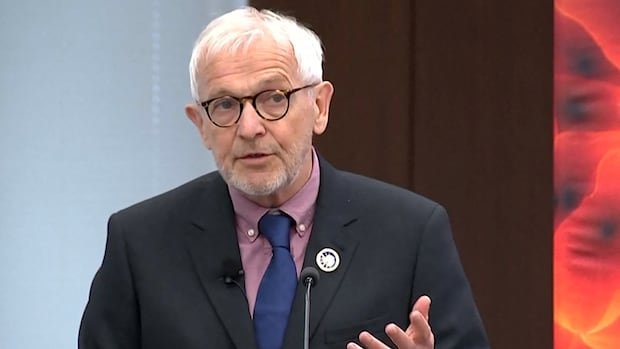


Belgian-American physicist Francis Halzen, aged 82, was named the recipient of the 2026 Nobel Prize in Physics in Stockholm on Tuesday. The award was given in recognition of his significant contributions to the IceCube Neutrino Observatory and the discovery of high-energy neutrinos of astrophysical origin situated at the Amundsen–Scott South Pole Station in Antarctica.
Halzen’s innovation in utilizing ice at the South Pole to track neutrinos, also known as “ghost particles” due to their ability to traverse Earth and organisms without leaving a trace, was praised. The Royal Swedish Academy of Sciences highlighted the importance of these neutrinos as messengers from the cosmos, providing insights into distant galaxies and the phenomena of exploding stars.
Annually, the Nobel Physics Prize winners are chosen by the Royal Swedish Academy of Sciences and are awarded a total prize sum of 12 million Swedish crowns ($1.7 million Cdn). The IceCube Neutrino Observatory, covering an entire cubic kilometer, began operations in 2011 after years of planning and development.
Halzen expressed his gratitude to his collaborators over the years and shared his surprise and delight at the announcement while attending a conference in Italy. Referred to as “Neutrino Man” by the U.S.-based Smithsonian magazine in 2014, Halzen’s work on studying neutrinos has opened new avenues in understanding the universe’s evolution.
The observatory station, which accommodates numerous activities and up to 150 individuals, is set to undergo an extension known as IceCube-Gen2. This expansion, covering eight cubic kilometers of ice, aims to enhance neutrino detection capabilities, including the identification of weaker neutrinos, upon its projected operational launch in 2033.
Halzen emphasized that the full impact of his work is yet to be revealed, anticipating further discoveries in astronomy. Belgian Prime Minister Bart De Wever lauded Halzen’s dedication to unraveling cosmic mysteries through microscopic manifestations. The Swedish academy acknowledged the discovery of neutrino oscillations in 2015, with Canadian scientist Dr. Arthur McDonald sharing the Nobel Physics Prize that year.
The Nobel Prize in Chemistry, literature, peace, and economics will be announced in the following days, keeping the tradition established by Alfred Nobel, the inventor of dynamite, who aimed to recognize individuals benefiting humanity. The laureates will receive their prizes on December 10, the anniversary of Nobel’s passing.