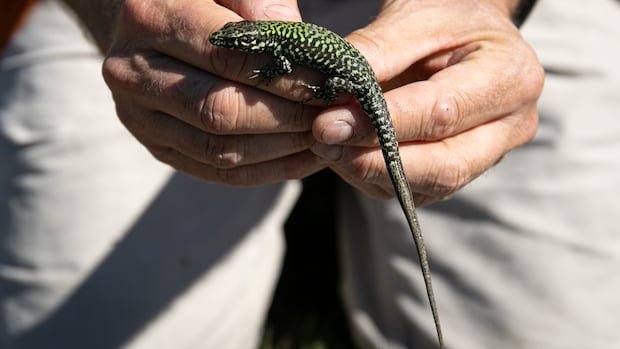


Tracy Menzies faced a persistent slug problem in her backyard garden, but this year, her strawberries flourished without slug interference. The reason behind the slugs’ decline seems to be the increasing presence of the European wall lizard in the area. These invasive lizards have been rapidly spreading across Vancouver Island, preying on various insects and slugs.
Menzies, a resident near the Gorge Waterway in Saanich, noticed a surge in lizard numbers in her yard recently. She observed these small lizards, ranging from a few inches to over eight inches, actively foraging in her garden. Gavin Hanke, a curator at the Royal B.C. Museum, estimated the population of European wall lizards in B.C. to be between 800,000 to a million, mainly concentrated on Vancouver Island and extending as far as Campbell River.
Hanke expressed concerns about the lizards’ impact on the local ecosystem, particularly their predation on invertebrates like baby garter snakes. Nicholas Wong from the Invasive Species Council of B.C. highlighted the lack of management programs to control the lizard population growth. The initial release of 12 lizards in 1970 led to their proliferation, finding a favorable habitat due to the mild winters and warm summers on Vancouver Island.
These omnivorous lizards have a diverse diet, consuming insects, spiders, and fruits like figs. While they aided Menzies in protecting her strawberries, she remains wary of their spread and the potential need for control measures. Hanke suggested maintaining a “boring” garden to deter the lizards, emphasizing the challenge of eradicating them due to their rapid expansion and adaptability to various environments.
Despite the unfavorable consequences of introducing these lizards, Hanke acknowledged that it is now too late to completely eliminate them. He urged against relocating them to new areas, cautioning that such actions could further extend their range. The curator warned that it might only be a matter of time before the lizards reach Washington state due to human-induced habitat alterations and unintentional introductions.