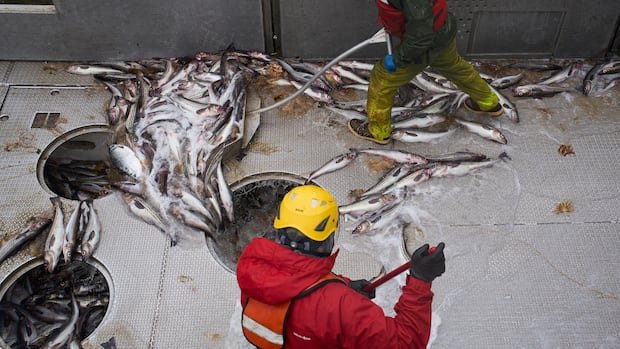


A dense haul of Alaska pollock emerged from the tumultuous Bering Sea waves, with the fish tightly packed in the netting, even allowing their heads to protrude through. Among the catch, various other marine creatures were unintentionally ensnared, including crabs, jellyfish, and notably, salmon, sparking a contentious debate surrounding industrial trawling practices in Alaska.
Maverick Blake, the captain of the vessel, acknowledged the challenge of encountering non-target species in the wild capture fishery, emphasizing the necessity of such operations to supply seafood to consumers. To mitigate salmon bycatch, Blake altered course to a different fishing area where salmon encounters were expected to be fewer.
Alaska pollock, a significant fishery worldwide, serves as a key ingredient in popular food items like McDonald’s Filet-O-Fish sandwiches, fish sticks, and imitation crab. Despite efforts to minimize environmental impact in the fishery, the nets used to catch pollock inadvertently trap other marine life.
Bycatch, referring to unintended catch while targeting specific species, accounts for around two percent of the total pollock fishery catch, translating to substantial numbers of salmon caught annually. The decline in salmon runs across western Alaska, affecting Indigenous communities heavily reliant on salmon, has intensified opposition to trawling practices and bycatch.
In recent years, contentious debates over salmon catches have permeated Alaska’s political landscape, influencing gubernatorial and U.S. Senate races as candidates grapple with balancing conservation measures and economic interests. Measures such as fishing bans and restrictions have been implemented to aid salmon populations in the face of changing ocean conditions.
Efforts onboard vessels like the F/V Progress aim to minimize salmon bycatch, with captains employing various strategies to avoid catching salmon. The fishery implements rigorous monitoring and management practices to track bycatch, with the industry emphasizing continuous improvement in salmon avoidance measures.
While the debate primarily focuses on the impact on rivers and local communities, concerns extend to the broader ecosystem and habitat damage caused by trawling operations. The frustration surrounding trawling practices has garnered diverse support from various stakeholders, highlighting the complex interplay between economic interests and conservation efforts.