


The Federal Communications Commission (FCC) announced on Wednesday that it has granted permission to Elon Musk’s SpaceX to deploy a network of one million satellites for space-based data centers.
Earlier this year, SpaceX applied for authorization to launch as many as one million orbital computing modules aimed at processing vast quantities of data for use on Earth. The FCC stated that it has approved the SpaceX “Starmind” constellation to address the surging demand for AI computing capabilities.
According to the license conditions, SpaceX is required to commence deployment by November 2033, with 10 percent of the total—equating to 100,000 satellites—needed to be launched by November 2035, and 50 percent by November 2038, as specified by the FCC.
The FCC noted that granting this application would enable SpaceX “to lead in innovative technology that promotes American dominance in both space exploration and artificial intelligence.”
Data centers serve as the essential infrastructure for artificial intelligence, demanding enormous energy resources.

Protesters are advocating for a halt to the construction of large AI data centers throughout Europe. These facilities have become a focal point for widespread concerns regarding artificial intelligence due to their significant energy and water consumption in developing and operating the technology.
“By effectively utilizing near-constant solar energy with minimal operational or maintenance expenses, these satellites are poised to deliver remarkable cost and energy efficiency while greatly diminishing the environmental footprint linked to traditional data centers on Earth,” SpaceX informed the FCC.
It remains uncertain whether SpaceX will actually launch one million satellites, given that approximately 17,000 satellites are currently in orbit. Satellite operators often request authorization for more satellites than they plan to deploy to maintain design flexibility.
-
Under attack: How humanity is losing the night sky
-
SpaceX wants to launch a million satellites. Here’s how that could impact the atmosphere and the night sky
Before starting the deployment of the Starlink system, SpaceX had sought authorization for 42,000 satellites. Their expanding network now comprises over 11,000 satellites in orbit.
SpaceX’s proposal heavily relies on the anticipated reduction in costs associated with Starship, the company’s next-generation reusable rocket currently under development, to facilitate the satellite launches.
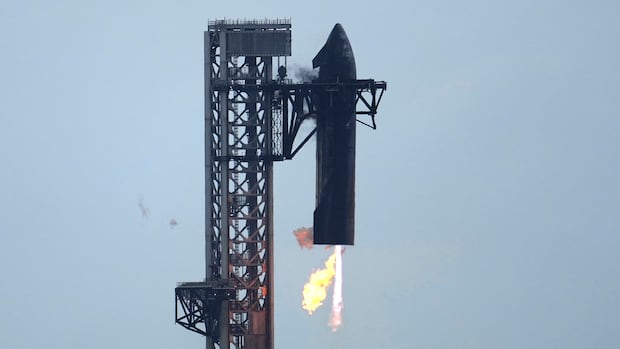
Cheers erupted as SpaceX’s Starship spacecraft returned on Saturday from its longest orbital flight to the launch tower in Texas, demonstrating a significant milestone in the company’s decade-long mission to create a fully reusable rocket system.
Critics of the plan, including Amazon’s satellite division Leo, have voiced concerns that SpaceX may not deploy all the satellites and that the process could extend over centuries. However, FCC Chair Brendan Carr dismissed these concerns in March.
“Amazon should concentrate on organizing its own satellite launches and constellation instead of worrying about others who are actively launching satellites at the speed and frequency that SpaceX is,” Carr remarked.
The FCC also stated it has approved additional communications requests from SpaceX to enhance its optical network.