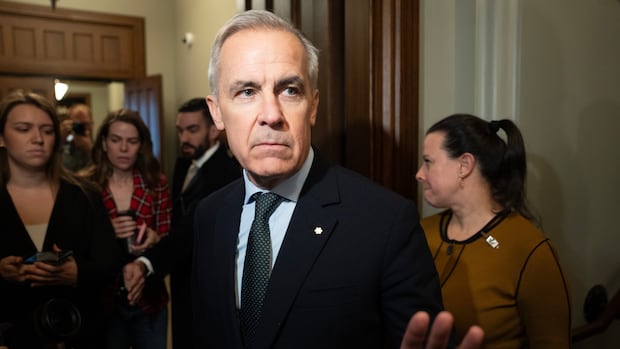


Prime Minister Mark Carney stated that U.S. President Donald Trump has not discussed concerns regarding Canada’s contributions to North American defense, despite recent criticisms from the Pentagon.
Pete Hegseth’s Department of War criticized Canada earlier this week, asserting that the country fails to fulfill its commitments to NORAD and NATO and is focusing too heavily on its economic interests, which adversely affects their collective military efforts and American taxpayers.
On Tuesday, the Pentagon issued a new warning, indicating that it would consider implementing more serious actions if Canada does not comply with its demands.
Carney remarked, “The commander-in-chief of the U.S. military is the president of the United States. I can assure you that in my conversations with the president, our focus is on global conflict resolution.”
“He has not brought up topics as reported in the media recently.”
Last week, senior Pentagon official Elbridge Colby expressed a desire for “more contributions from Canada” during a NATO meeting. Following that, it was revealed on Friday that the U.S. military has now imposed limitations on interactions with Canadians.
The Pentagon intensified its critique of Canada on Monday by distributing a “fact sheet” that targeted the nation’s defense budget, claiming that Canada is not a reliable partner.
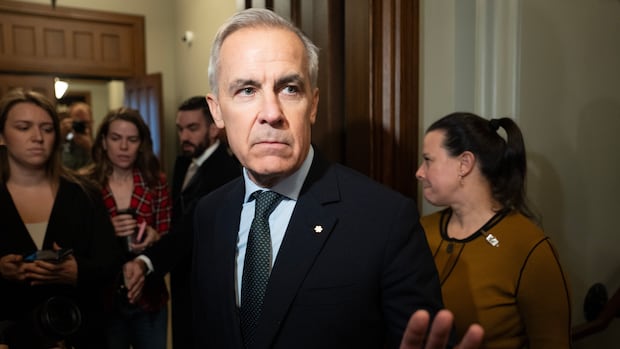
In response to the Pentagon’s claim that Canada is not contributing adequately to North American defense, Prime Minister Mark Carney noted that his recent talks with U.S. President Donald Trump have concentrated on ‘conflict resolution globally.’
On Wednesday, Carney addressed the issue for the first time, asserting that Canada is making “historic investments” in its military and defending its collaborative efforts within NATO.
“Canada is taking charge of our defense responsibilities,” Carney stated. “We are actively engaged in NATO’s defense initiatives, specifically Operation Reassurance in Latvia. We collaborate closely with our NATO allies, including the United States, as well as the Nordic countries, Germany, and France, across the High North, the Arctic, and throughout Europe to the Baltics.”
Stephen Saideman, a defense specialist at Carleton University, commented that the underlying issue is that Hegseth is attempting to “pressure” Canada into abandoning its strategy to diversify defense spending and reduce dependence on the U.S.
Carney mentioned last year that over 75 cents of every dollar allocated for capital defense spending goes to the U.S., which he deemed “not wise,” pledging to increase domestic spending.
‘We’ll make our own decisions’
When asked by CBC News if the government plans to modify its strategy in light of the Pentagon’s recent warning, Secretary of State for Defence Procurement Stephen Fuhr indicated that they are unlikely to abandon the diversification initiative.
“The minister of national defense has clearly stated that we are a sovereign nation and will make our own choices,” Fuhr asserted.
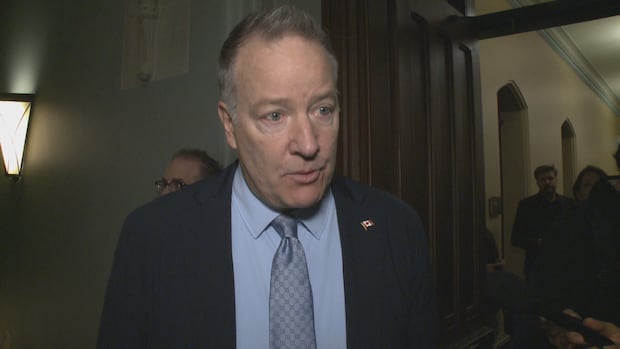
When addressing a senior Pentagon official’s threat to consider ‘significant mitigation measures’ if Canada does not accelerate its defense investments for North America, Secretary of State for Defence Procurement Stephen Fuhr emphasized that while Canada will continue to collaborate with the U.S., ‘we are a sovereign nation.’
Fuhr noted that he does not have specific figures regarding the decline in U.S. defense spending but acknowledged that “there has been a noticeable shift.”
“We are still purchasing from the U.S.,” he stated. “However, we are increasingly focusing on domestic purchases. We are also collaborating more with other partners.”
He highlighted Canada’s acquisition of Boeing P-8 Poseidon surveillance aircraft and HIMARS rocket launchers as examples of ongoing American purchases. He mentioned that many other products also incorporate U.S. components.
“Thus, the U.S. continues to receive a portion of nearly everything we do,” he concluded.
He expressed that Canada “produces quality products domestically” and needs to foster its economy.
When asked what message he would convey to Hegseth, Fuhr replied, “Perhaps he should get an updated briefing on Canada’s current efforts, to recognize the pace and extent of our advancements — which is significant.”