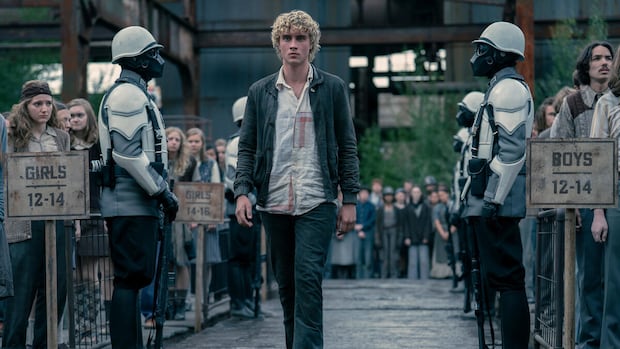


It’s hard to imagine a more challenging entry point into the The Hunger Games franchise than the latest prequel, Sunrise on the Reaping.
At first glance, this statement might appear absurd. With five films already released in this young-adult, Battle Royale-inspired series—four of which follow the journey of the “girl on fire,” Katniss Everdeen, as she strives to thwart the oppressive Capitol regime that forces randomly chosen children into brutal combat—you would expect viewers to be adequately informed.
So, as Sunrise on the Reaping revisits the past to share the tale of a seasoned character who once faced his own harrowing tournament, why does The Hunger Games feel the need to guide you through?
The answer lies in the intentions of its creator. As stated by director Francis Lawrence, his aim was to ensure that Reaping serves as a genuine entry point for both newcomers and longtime fans, regardless of their prior exposure to the series—striving to create an engaging, mid-level action film featuring fresh faces while allowing it to stand independently.
This is an ambitious set of objectives—one that Reaping accomplishes to some extent, emerging as a relatively notable addition to the crowded and often clichéd young-adult post-apocalyptic genre.
However, in addressing the second goal, it either falls flat or just barely succeeds, resulting in one of the more unusually bleak entries in the “chosen one” narrative realm.
Instead of following the resilient and often thwarted heroine Katniss, we delve into the troubled past of Haymitch Abernathy—a character primarily known for his discontent—and discover what led to his intriguing brokenness upon his first introduction to fans.
This might intrigue those who have been invested in the series from the outset, eager for more of the story.
But for viewers lacking any context about who eventually prevails in the decades following this unyielding, unromantic struggle, Reaping presents a different experience. Its depiction as a painful, almost universally nihilistic and relentlessly grim background for a single character renders it a peculiarly strange film when considered on its own.
Originally portrayed by Woody Harrelson as a battle-worn veteran of the games, Haymitch is now played by Joseph Zada. The storyline takes place 24 years before the events of the first film, right before what is known as the Second Quarter Quell.
This term refers to a significant Hunger Games event, one that those familiar with the series understand resulted in even greater carnage and anguish than usual—leaving an older, angrier Haymitch watching in fury as the corrupt government displayed manipulated, propagandistic footage of it in the original film.
However, for those unfamiliar with the narrative, this movie could lead to either a heroic victory or a tragic martyrdom.
Such expectations seem likely as we navigate the standard setup: music video-style sequences of Haymitch promising his companion Lenore (Whitney Peak) in a slight southern drawl that he will never abandon her; Haymitch sacrificing himself to protect her by becoming the “tribute” for his district—the most pitiable and underprivileged district in all of Panem; and his sarcastic slow-clapping at the detached President Snow (Ralph Fiennes) as he watches the moaning and dying young contestants in the arena below.

Ralph Fiennes as President Snow in a still from The Hunger Games: Sunrise on the Reaping. (Lionsgate)
These elements serve as expected and effectively executed moral and narrative cues for the tragic or victorious storyline. They gain more substance once the main plot unfolds, as the enigmatic Beetee Latier (Kelvin Harrison Jr.) emerges from the shadows of the arena compound to present Haymitch with a scheme to dismantle the Capitol from within, opting to forgo victory in the competition to prevent the ruling class from exploiting them.
However, there’s a significant issue: should Haymitch choose this path, he will not make it out alive.
Naturally, since this serves as the backstory for a character who is still alive in other Hunger Games films, this outcome seems improbable. Yet rather than spoil the experience for those aware of the broader ending, it only diminishes it: what was once an intriguingly mysterious, hinted-at trauma in Haymitch’s past devolves into approximately 30 minutes of excruciating, montage-driven alcoholism and a plethora of tiny coffins, reminiscent of a Dracula-themed dollhouse.
While the sorrowful compilation of trauma in Reaping‘s latter half may solidify and simplify older fans’ perceptions of Haymitch, it becomes utterly bewildering for newcomers. Instead of presenting a tale about overcoming fascism—be it genuine, performative, or pyrrhic—we encounter a harsh twist that lacks both a coherent emotional framework and a clear message.
-
REVIEW
Club Kid is one of TIFF’s best. It might make you cry
-
REVIEW
Ebenezer review: Merry Christmas, Johnny Depp! Is this your comeback yet?
A vague theme surrounding learned helplessness does emerge—the “implicit submission” of the populace obeying a minority, a concept articulated by philosopher David Hume, as The Hunger Games author Suzanne Collins has noted. Indeed, the individuals in Reaping fail to recognize their potential power to resist.
However, apart from a clichéd, hastily tacked-on conclusion—whose emotional resonance relies entirely on the assumption that you are familiar with Katniss Everdeen’s future victories—the remainder feels like punishment for the sake of punishment.
The drawn-out, grim depiction of the futility of Haymitch’s life serves to clarify his later resentment—a useful detail for those who eventually watch the first film. Yet aside from the novelty of a narrative denying you redemption or satisfaction, there is little else for newcomers engaging with this tale.
With the true conclusion of Sunrise on the Reaping being The Hunger Games, it might be wiser to start there. Or perhaps, not start at all.