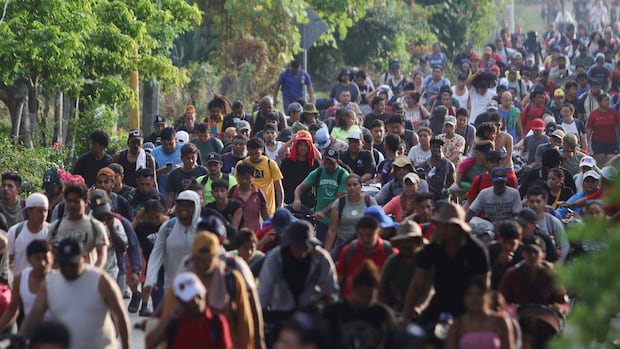


Inspired by the outcomes of the recent U.S. midterm elections, hundreds of migrants are journeying from southern Mexico towards the U.S. border.
In response to a warning from the U.S. president, the Mexican government has downplayed the issue and is attempting to encourage them to return home.
The caravan, comprising approximately 800 individuals, is the largest group heading to the U.S. this year, consisting of migrants from various Central American and Caribbean nations, including Honduras, El Salvador, and the Dominican Republic.
Many migrants are hopeful that the recent congressional shift, with Democrats now controlling both the House of Representatives and the Senate, might indicate a potential easing of immigration enforcement. This belief has driven them to embark on the challenging trek to the U.S. border, even though they have minimal chances of successfully entering the country.
U.S. President Donald Trump has warned that tariffs on Mexican goods will be doubled if Mexican authorities do not stop the caravan. The stakes involve hundreds of billions of dollars in trade.
“MEXICO MUST STOP THEM, NOW, and if they do not do so, the Tariffs on Mexico will be IMMEDIATELY DOUBLED,” Trump declared on his social media platform Truth Social on November 12.
“There will be no leniency!”
‘We don’t eat sometimes. We walk a lot’
This isn’t the first instance where Trump has issued threats to Mexico regarding migrant caravans. In 2018, during his initial term, he called on U.S. Congress to implement stringent border legislation using the “nuclear option if necessary” to stem the ongoing flow of migration.
Under the Trump administration, strict border policies were established that effectively halted caravan movements.
The current caravan, referred to as Dios con Nosotros (God With Us), is presently in Chiapas, a southern state of Mexico. The group is traversing between 13 and 32 kilometers daily.
Katheryn Esmeralda, a caravan participant, was deported from the U.S. six months ago following a workplace raid in Atlanta. She had been living in the U.S. since the age of 15, while her entire family, including her three children, still resides there.

Katheryn Esmeralda, right, rests with Esther María Aquino, centre, and an unidentified friend in Mapastepec, on their way to the Mexico-U.S. border. (Juan Manuel Blanco/CBC)
“I am coming here because my entire family is in the United States. All my kids are over there,” Esmeralda, originally from El Salvador, shared with CBC News in Mapastepec, Chiapas.
Esther Maria Aquino, who hails from Tela Atlántida in Honduras, was also recently deported from the U.S. and hopes to reconnect with her parents in Texas. She has already covered about 180 kilometers since her departure from the Guatemalan border to Pijijiapan in Chiapas.
Aquino described the arduous journey, saying, “We don’t eat sometimes. We walk a lot, you know. It’s so bad,” she noted.
The group has approximately 2,000 kilometers remaining before they reach the U.S. border.
This week, Mexican President Claudia Sheinbaum stated that since Trump took office in January 2025, there have been 24 caravan formations, but none have made it to the U.S.-Mexico border.
“We inform the individuals in the caravan that entering the United States is quite challenging, and if their objective is to reach the U.S., that possibility does not exist,” she remarked.
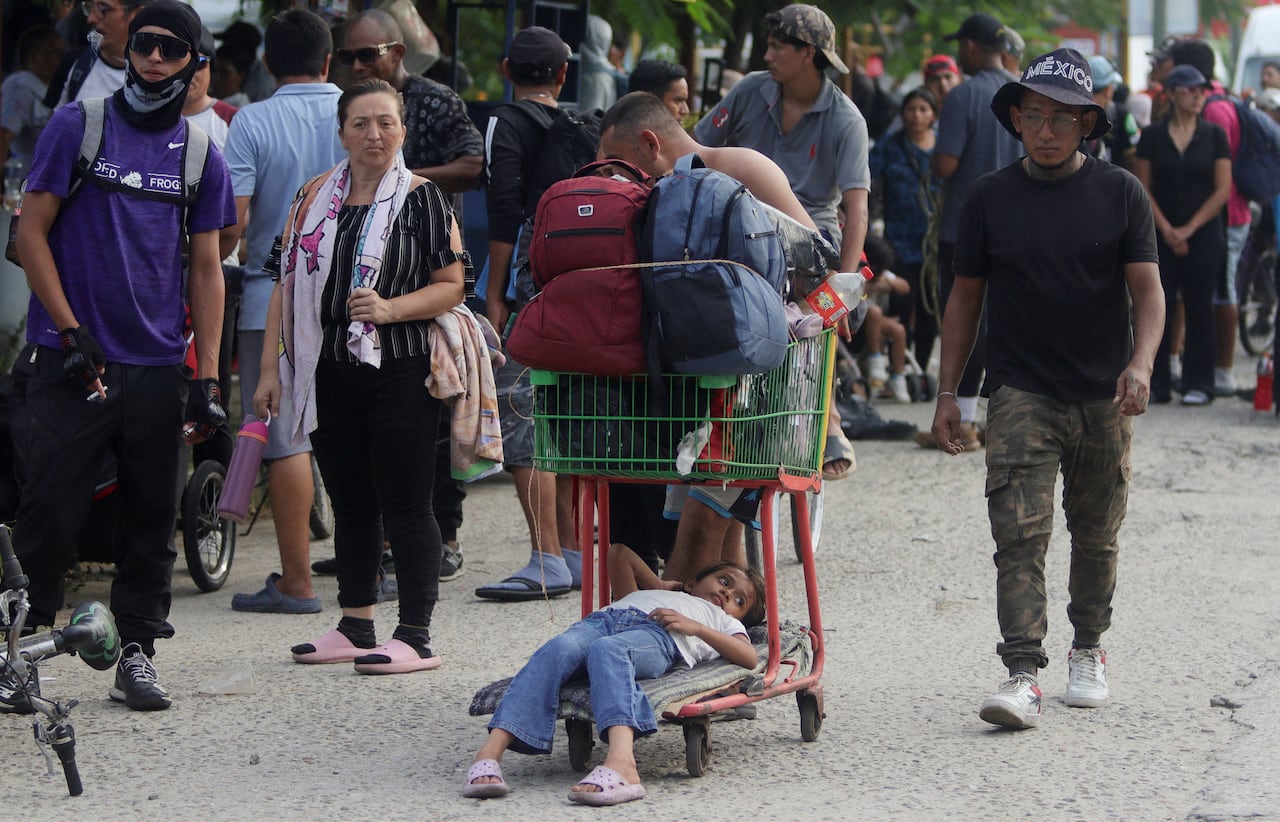
A migrant girl lies on a shopping cart with luggage while travelling toward northern Mexico on the way to the U.S. border, in Mapastepec on Tuesday. (Damian Sanchez/Reuters)
‘Humanitarian visas’ needed, advocate says
“Individuals are misinformed, believing that changes will happen swiftly simply due to Democratic victories in various states and … in Congress,” stated immigration attorney Soraya Vázquez.
Vázquez, who serves as the deputy director of Al Otro Lado’s Tijuana office, a binational non-profit organization, emphasized that the Mexican government should provide accurate information to migrants regarding the realities they face when attempting to cross, rather than merely devising strategies to block them from reaching the northern border at all costs.
“A crucial strategy would involve requiring bus operators to verify legal immigration documentation prior to selling tickets or allowing passengers to board,” she explained. “Mexico needs to launch an extensive information campaign and, perhaps, offer humanitarian visas.”

Soraya Vázquez is an immigration lawyer and deputy director of the Tijuana office of the non-profit organization Al Otro Lado in Mexico. (Submitted by Al Otro Lado)
These visas would provide migrants from outside Mexico with legal immigration status, allowing them to reside in areas with job prospects while they await conditions to improve, enabling them to eventually reach the United States.
Advocates indicate that the primary group within the caravan is dwindling daily, as some participants grow weary of the journey and return home, while others approach Mexican authorities seeking asylum or a return option.
“The Mexican government employs numerous euphemisms, but ultimately, it aims to contain individuals and send them back to the south of the country or to their places of origin,” Vázquez stated.
For migrants, traversing Mexico on foot remains the only way to reach the U.S. However, even if they manage to arrive at the border, stringent immigration enforcement severely limits any chances of obtaining a visa.
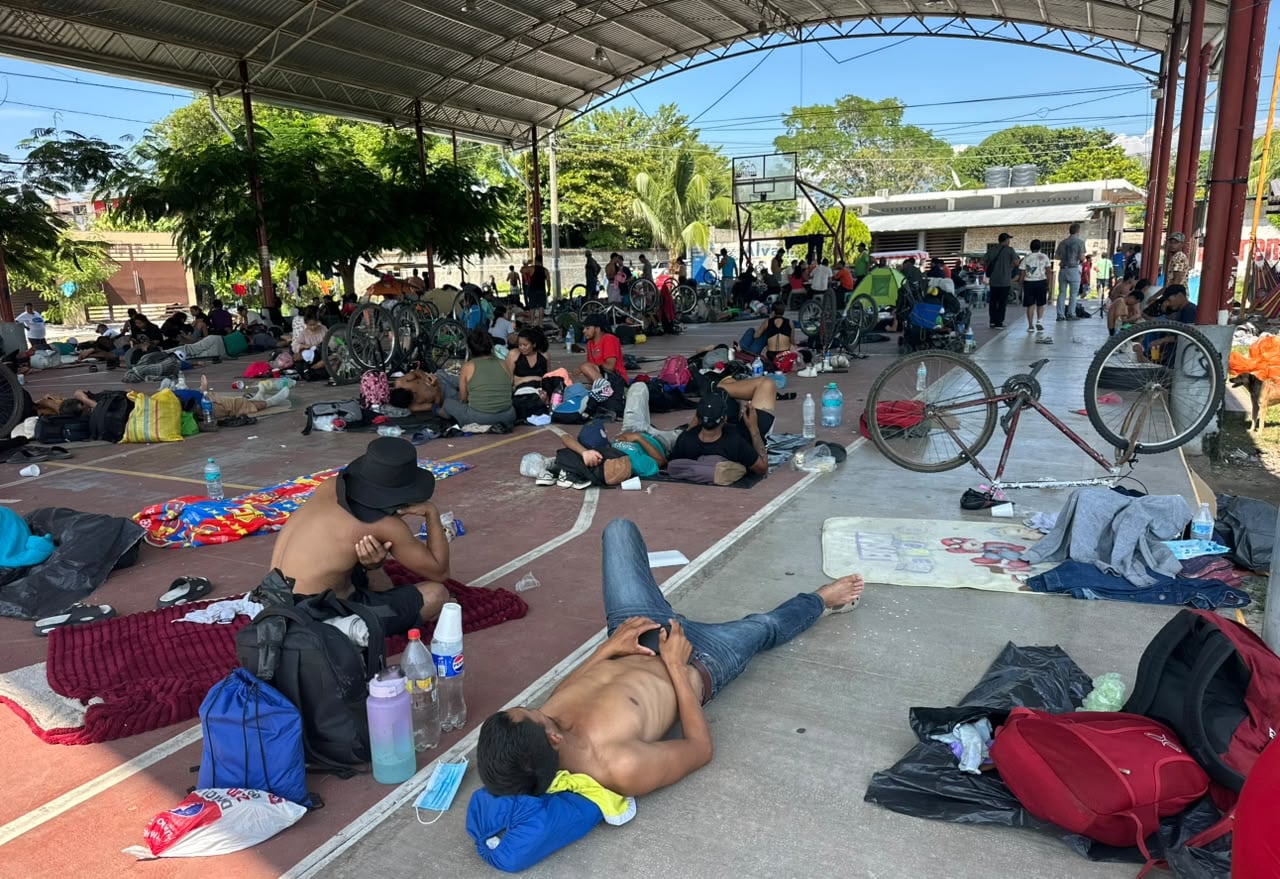
Migrants in the caravan travelling through Mexico rest in Mapastepec. The caravan of about 800 people is made up of migrants from several Central American and Caribbean countries, including Honduras, El Salvador and the Dominican Republic. (Juan Manuel Blanco/CBC)
A Mexican federal official informed CBC News that “migration is not criminalized; migrants receive assistance, and their cases are assessed based on their vulnerable group status, with many returning to their home countries.”
“Mexico must provide them with options, a humanitarian alternative,” Vázquez asserted. “A one-year humanitarian visa, renewable for a second year, while they await changes in border regulations.”
Nevertheless, individuals like Esmeralda are determined to achieve their goal: to reunite with their families without enduring a lengthy wait.
“My little daughter is currently four years old. She calls me and says, ‘Mom, I miss you,'” she expressed. “I’m in tears because she’s just a baby right now and she needs me.”