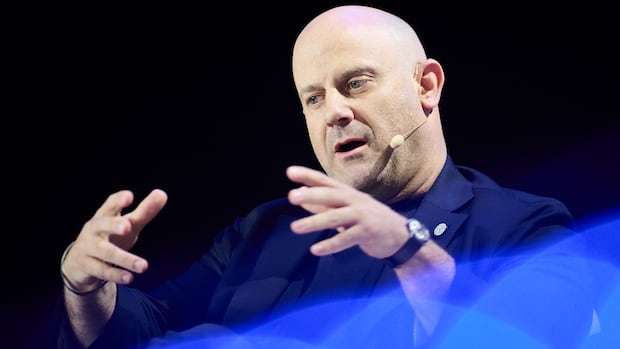


Dominion Dynamics, a defence technology firm located in Ottawa, has secured a partnership with Telesat, a prominent Canadian satellite company, paving the way for the creation of a domestic alternative to Elon Musk’s Starlink.
The $2.2 million collaboration, revealed on Thursday, forms part of a wider initiative aimed at enhancing the Canadian military’s control over the technologies essential for Arctic defense.
This agreement will enable both companies to create robust, portable satellite antennas that can link soldiers and unmanned military drones to Telesat’s upcoming Lightspeed constellation of low-Earth-orbit satellites.
For Telesat, this agreement comes as welcome news, especially as the company grapples with a significant debt maturity challenge. Approximately $3.1 billion related to Telesat’s legacy satellite operations is set to mature between December 2026 and October 2027.
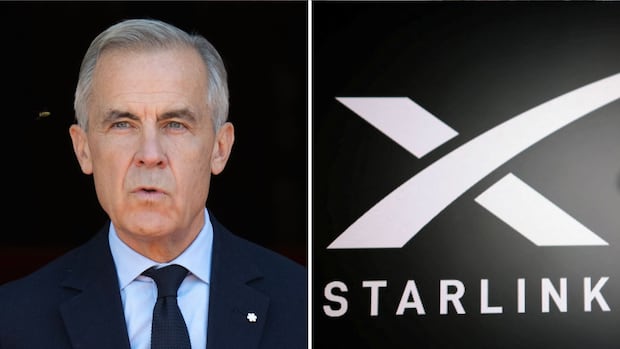
Prime Minister Mark Carney states that Canada aims to ‘diversify away’ from Elon Musk’s Starlink as it seeks to lessen its dependence on U.S. technology. However, with the Canadian alternative Telesat Lightspeed still years from full implementation, how challenging will this be?
Creditors have allowed Telesat until January 18, 2027, to reorganize its legacy operations, which are distinct from the low-Earth satellite division collaborating with Dominion.
The initiative with Dominion, which benefits from financial aid from the National Research Council, aims to provide Canadian forces with a secure communications framework independent of any U.S. commercial service provider.
Prime Minister Mark Carney has expressed concerns regarding the risks of relying on a single technology supplier, whose choices could significantly impact national sovereignty.
Eliot Pence, the founder and CEO of Dominion Dynamics, highlighted that the recent situation in Ukraine has underscored the necessity for Canada to explore alternatives.
“Clearly, we’ve witnessed Starlink being disabled in Ukraine,” Pence commented. “What we are really constructing here is an addition to that [communications] framework.”
The technology under development will facilitate direct communication between military units and autonomous aircraft through the Telesat network, which is under Canadian control.
Pence characterized the design as akin to Starlink’s portable satellite terminals but tailored specifically for military operations in the harsh conditions of Canada’s North.
“Envision it as a Starlink Mini, but a Telesat Dominion Mini,” he explained. “It’s a sovereign communications link specifically engineered for the Arctic” with military-grade specifications.
Starlink remains a challenge
However, this partnership does not imply that Canada is ready to completely forsake Starlink.
Pence noted that the vast satellite network operated by the American company makes it challenging to avoid entirely.
<p“It will require some degree of interoperability with Starlink because their satellites are much more widespread,” he stated.
Instead, he emphasized that the objective is to guarantee that Canadian commanders have viable options if one communications network becomes unavailable, unreliable, or politically sensitive.
Dominion’s current communication technology is engineered to manage multiple networks, enabling military systems to switch between them as needed.
The company plans to create two prototype terminals: a lightweight version suitable for soldiers to transport in the field and a larger variant designed for unmanned aircraft and other autonomous military systems.
Both prototypes are being designed to endure extreme cold and function in remote areas with limited facilities.
The Canadian military is expected to be the primary customer, although no defense procurement contract has yet been confirmed.
According to Dominion, this technology could ultimately be utilized by the Canadian Rangers, the Coast Guard, the RCMP, and emergency responders operating in northern regions.
Nonetheless, there is a significant obstacle to overcome.
Governments are spending billions on the autonomous arms race — should Canada join in? For The National, CBC’s Jennifer Yoon examines the future of AI-powered military weapons, what it means for international humanitarian law and where Canada fits in.
Telesat needs to launch its Lightspeed constellation and make it operational first. The company currently anticipates starting commercial services at high latitudes by the end of March 2028.
The agreement with Telesat is among several collaborations that Dominion announced this week as it seeks to position itself as a significant player in the rapidly evolving market for autonomous military aircraft.
On Friday, the company revealed that, beyond developing the Telesat receiver, it has engaged the satellite manufacturer and various other Canadian businesses for the Scout, its uncrewed combat aircraft.
-
Musk says he was behind Starlink speed restriction in Ukraine
-
The age of AI warfare has dawned. Is Canada ready?
Additional contributors to the Scout development include Thales Canada, Top Aces, ITPS Canada, PV Labs, SRC Can, Altitude Aerospace, Groupe DCM, HSB Solutions, North Aircraft Industries, and RAMPF Composite Solutions.
On Tuesday, the company announced a partnership with Pratt & Whitney Canada to deliver the propulsion system for the Dominion Scout, designed to operate in conjunction with traditional fighter jets.
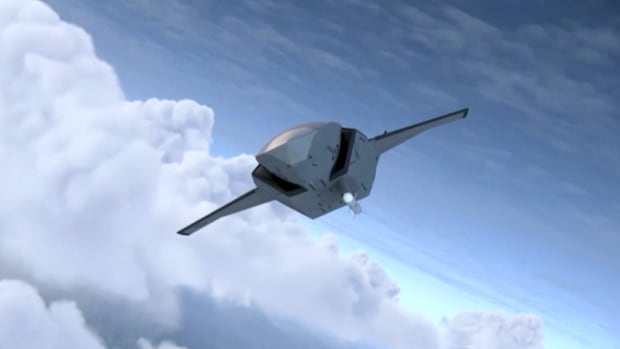
Scout is expected to operate over long distances in the Arctic, conduct surveillance, and potentially execute strikes on hostile targets.
The aircraft will utilize a Canadian-manufactured PW300-series engine.
Pence emphasized that obtaining an engine supplier was a vital achievement for a project still under development.
“You don’t truly have an aircraft until you have a propulsion system,” he remarked.