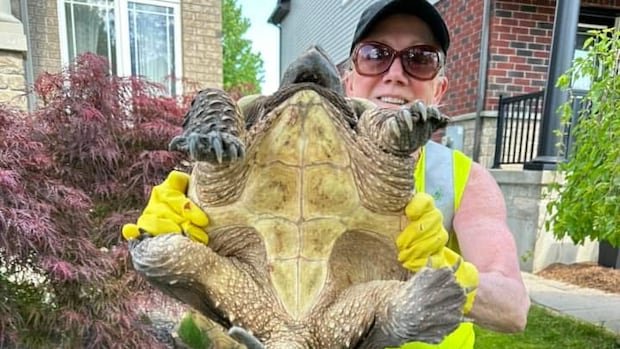


Driving through Wellington County and encountering a turtle on the road? A new emergency hotline is now accessible to provide assistance. Established in August, the Wellington Turtle Conservation Group has introduced its own hotline in response to the high mortality rate of turtles in the county.
Sandy Nicholls, the founder of the Wellington Turtle Conservation Group, emphasized the urgent need for the hotline due to the significant presence of wetlands, gravel pits, and turtles in Wellington County. She mentioned that many individuals would contact the group’s social media platforms regarding stranded turtles but often omitted the location details.
The turtle hotline is designed to ask specific questions to pinpoint the exact location of the stranded or injured turtle. Nicholls highlighted the hotline’s importance, particularly during nesting season when male turtles are most active in May and females in June. The predominant turtle species in Wellington County, primarily snapping turtles and painted turtles, are facing a rapid decline.
Nicholls shared distressing accounts from landowners who have witnessed a substantial decrease in turtle populations in recent years. The decline is attributed to road fatalities, loss of habitat, and illegal poaching, with snapping turtles classified as a species at risk in Ontario.
While Midland and eastern painted turtles are federally listed as species of special concern, this designation does not extend to Ontario. The government of Canada attributes the decline of painted turtles to the loss of approximately 70% of wetlands in southern Ontario over the past two centuries.
Nicholls emphasized the importance of contacting the hotline even if a turtle appears deceased or severely injured. Injured turtles are transferred to the Ontario Turtle Conservation Centre for medical treatment, including procedures like using pins and screws for rehabilitation. Additionally, even if a deceased female turtle is found, there is a possibility of extracting and incubating its eggs for conservation purposes.
The efforts of the Wellington Turtle Conservation Group involve responding to turtle-related incidents, safeguarding nests, rescuing hatchlings, and releasing them into suitable environments. Nicholls also mentioned the availability of a hotline operated by the Ontario Turtle Conservation Centre for reporting injured turtles across Ontario.
For assistance from the Wellington Turtle Conservation Group hotline, individuals can dial 226-906-7014.