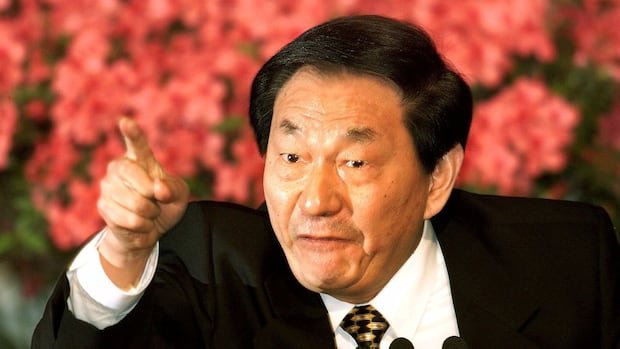


Former Chinese premier Zhu Rongji has passed away at the age of 97, as reported by state media. The official Xinhua news agency announced that Zhu succumbed to illness in Beijing at approximately 11 a.m. on Wednesday. Known for his impatience and sharp-tongued demeanor, Zhu played a pivotal role in sparking China’s rapid economic growth by implementing significant reforms within the state industry during the 1990s and steering China’s entry into the World Trade Organization.
Initially exiled to rural areas for endorsing reforms in other communist nations, Zhu later spearheaded a series of transformative initiatives during his tenure as premier, a position he held from 1998 to 2003. Despite facing resistance from Communist Party traditionalists and state industry leaders, Zhu championed the restructuring of state-owned enterprises to enhance efficiency and profitability. This restructuring, which led to millions of job losses, ultimately propelled China to surpass Japan as the world’s second-largest economy after the United States in 2010.
Expanding on the reforms initiated by former leader Deng Xiaoping in 1979, Zhu was instrumental in orchestrating groundbreaking changes such as China’s accession to the WTO, a move that significantly bolstered China’s position as the world’s largest exporter. These reforms also contributed to sustaining economic growth above eight percent annually from 2000 to 2010, reaching a peak of 14.2 percent in 2007.
Appointed as premier at the age of 69 in 1998, Zhu gained popularity for his willingness to critique government inefficiencies and corruption, often assuming responsibility for shortcomings. His no-nonsense approach earned him the monikers of “Boss” and “Madman Zhu,” underscoring his uncompromising stance on tackling corruption within the system.
Zhu, who ranked third in the party hierarchy behind President Jiang Zemin and Li Peng, played a pivotal role in curbing inflation as a deputy premier in the 1990s. He enforced price controls and curtailed financial support to state-owned enterprises operating at a loss, despite facing opposition from local officials—a strategy he would replicate in subsequent battles over the pace of reform.
Furthermore, Zhu spearheaded the efforts to secure China’s WTO membership through protracted negotiations that commenced in the 1980s. This achievement not only solidified China’s commitment to free trade but also empowered Zhu to dismantle local protectionist practices favoring specific companies.
While Zhu’s push for market-oriented reforms fueled China’s real estate boom in 1998 by initiating the sale of state-owned company apartments, he remained steadfast in retaining government ownership over key sectors of the economy. His instrumental role in devising plans to transition banks, airlines, oil companies, and other enterprises into profit-oriented entities while upholding state ownership underscored his pragmatic approach to economic transformation.
Born in Mao Zedong’s home province of Hunan on October 23, 1928, Zhu endured a prolonged period of political obscurity after being labeled a “rightist” in 1957 for endorsing reforms in Hungary and Yugoslavia. Following his rehabilitation in 1979, Zhu swiftly ascended the political ladder, assuming key roles in Shanghai’s municipal government before transitioning to national leadership positions.
Notable for his willingness to acknowledge government failures and assume accountability, Zhu distinguished himself by publicly apologizing for official shortcomings, including the mishandling of natural disasters and accidents. His candid approach and occasional self-deprecating humor endeared him to the public and helped humanize the party’s image amid economic reforms and political transformations.
Zhu’s legacy as a transformative leader and economic architect was exemplified by his role in crafting a tax system that mandated local officials to remit more revenue to the central government. His contributions to reshaping China’s economic landscape and navigating the complexities of global trade agreements solidified his reputation as a key architect of China’s modern economic prowess.