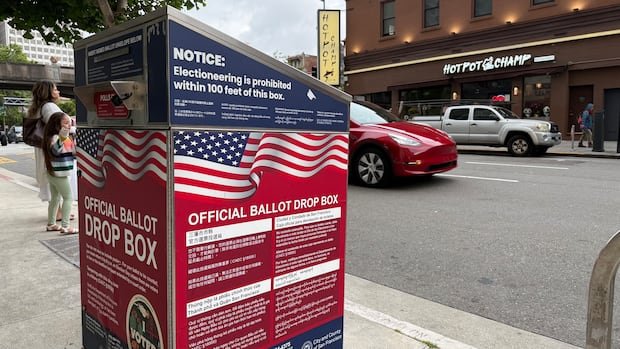


For several months, President Donald Trump of the United States has been attempting to impose fresh restrictions on mail-in voting, a method utilized by nearly one-third of American voters during elections. However, as the crucial midterms draw closer in less than seven weeks, the U.S. Supreme Court has intervened to stop a Trump administration initiative that could have prevented millions of individuals from casting mail-in ballots.
Mail-in voting holds significant importance in the U.S., with tens of millions of Americans opting for mail-in ballots in both presidential and midterm elections. The percentage of Americans utilizing mail-in voting witnessed a gradual rise through the 2010s, reaching 25% in 2018 and surging to 43% in 2020 amid the COVID-19 pandemic. In the 2024 presidential election, approximately 30% of the 158 million votes cast were through mail-in ballots, as reported by the U.S. Election Assistance Commission.
Contrastingly, the proportion of mail-in voters in federal elections in Canada remains notably lower. While a report by Elections Canada reveals that a record 1.25 million individuals utilized mail-in ballots in the 2025 general election through the special ballot process, this accounted for merely 6.3% of the nearly 20 million total ballots cast nationwide.
President Trump has expressed discontent with states that expanded access to mail-in voting for the 2020 presidential election, baselessly claiming that the election was stolen due to fraud involving mail-in voting. Research by the non-partisan Brookings Institution in Washington indicates that fraud in mail-in voting is extremely rare, with approximately four cases per 10 million mail-in ballots cast.
Despite numerous registered Republicans, including Trump, opting for mail-in voting in previous elections, evidence suggests that restricting mail-in ballots could benefit Republicans in tight congressional races and swing states. Studies by the MIT Election Data Lab and the Pew Research Center indicate that registered Democrats were more inclined to vote by mail in 2020 and 2024, albeit with a narrowing gap in the most recent presidential election. Additionally, Americans aged 65 and above are identified as the age group most likely to opt for mail-in voting.
Trump’s endeavor to restrict mail-in ballots involved granting the U.S. Postal Service authority over determining voters’ eligibility to receive mail-in ballots, deviating from the traditional state-led election management system. Trump issued an executive order in March directing federal agencies to compile lists of eligible voters, subsequently instructing the postal service to distribute ballots solely to individuals on these lists and implement a tracking system for mail-in voters.
However, this plan faced opposition from several states, leading to legal challenges and injunctions that impeded its implementation. The Supreme Court’s recent emergency ruling denied the administration’s request to lift the injunction, affirming the legality of mail-in voting for the upcoming midterm elections.
In response to the ruling, Trump criticized the court’s decision on his Truth Social platform, denouncing mail-in voting as a “disaster” and alleging that it facilitates cheating. While the court’s ruling appears to secure mail-in voting for the midterms, concerns persist that Trump may cast doubt on the results if Republicans lose control of the House or Senate. Attorney General Todd Blanche emphasized that the administration’s efforts to safeguard the integrity of elections through mail-in voting restrictions will persist beyond November.