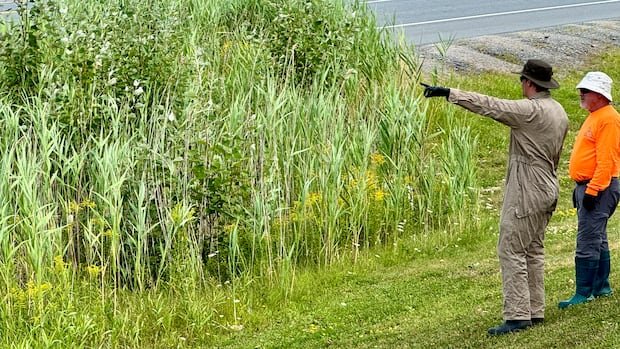


Communities in northern Ontario are banding together to address the spread of an invasive plant that poses a threat to local ecosystems. The Junction Creek Stewardship Committee, based in Sudbury, recently organized a workshop in collaboration with the Invasive Phragmites Control Centre to educate the public on identifying and managing the invasive phragmites, also known as common reed.
Invasive phragmites can form dense clusters, displacing native vegetation and disrupting wetland habitats. Jayden McGleish, a field supervisor at the Invasive Phragmites Control Centre, highlighted the plant’s encroachment into northern Ontario, including noticeable growth in Sudbury. The rapid proliferation of invasive phragmites can impede the movement of wildlife, such as turtles and frogs, and impact recreational areas by encroaching on shorelines and infrastructure like roads.
While the invasive plant is more prevalent in southern Ontario, it is increasingly being detected in northern regions like Sudbury, Sault Ste. Marie, Timmins, and Thunder Bay. Erik Barr from Conservation Sudbury emphasized the importance of proactive measures to curb the plant’s spread in Sudbury before it becomes uncontrollable.
Distinguishing between invasive and native phragmites is crucial for effective monitoring and management. Barr highlighted key differences, such as wider leaves and thicker stems in invasive phragmites compared to the native variety, which displays a reddish hue on its stems. Educating the public on these distinctions is vital, especially in areas where the plant can be inadvertently spread, like along roads and railways.
Jaclyn Groom from the Junction Creek Stewardship Committee stressed the significance of public awareness in identifying and reporting invasive phragmites sightings. The plant’s affinity for metal-rich soils near mining sites poses a particular challenge in regions like Sudbury. Effective treatment methods, demonstrated during the workshop, involve using backpack sprayers and herbicides to target and control invasive phragmites infestations.
Chuck Simpson, from the Invasive Phragmites Control Centre, outlined the treatment process, noting a high success rate in reducing the plant population. Although some regrowth may occur, proper management can significantly mitigate the invasive plant’s impact on local ecosystems. By fostering community engagement and implementing strategic control measures, northern Ontario communities aim to safeguard their natural environments from the threats posed by invasive phragmites.