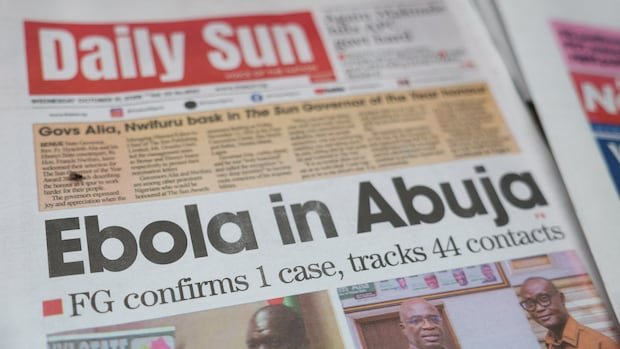


Nigeria has confirmed its first case of Ebola in over ten years, making it the fourth African nation and the most populous to be impacted by this rapidly spreading outbreak. The Ebola strain responsible for the outbreak has a high fatality rate, with no approved treatment or vaccine available. Since the initial cases were reported in the Democratic Republic of Congo in May, the disease has claimed the lives of 4,646 individuals. Concerns exist among health officials regarding the potential for misinformation and funding shortages to exacerbate the spread of Ebola within the region and beyond borders.
The case in Nigeria involves a Ugandan woman who arrived in the capital city, Abuja, via Addis Ababa on October 5. The Nigeria Centre for Disease Control confirmed her status, stating that she is currently isolated and receiving medical treatment. Contact tracing efforts are underway, with 44 individuals identified as potential contacts, including the patient’s husband, a Swiss national residing in Abuja.
Health Minister Muhammad Ali Pate reassured the public that Nigeria is equipped to handle the situation, citing the successful containment of Ebola in 2014 as evidence of their preparedness. Uganda’s Health Ministry disclosed that the infected woman had previously traveled to Congo, where a significant number of Ebola cases have been reported across multiple provinces. However, Uganda itself does not have any active Ebola cases at present.
The outbreak in the Democratic Republic of Congo, caused by the rare Bundibugyo strain, was declared in mid-May and has since evolved into the world’s second-largest Ebola outbreak. Africa’s leading public health agency has initiated support measures for Nigeria in response to this concerning development. Additionally, Kenya reported nine Ebola cases this month, all linked to an individual who had traveled from Congo.