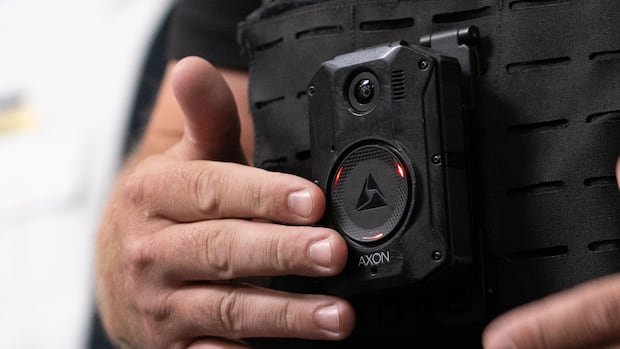


The Edmonton Police Service declared on Tuesday that they will be the first global police force to deploy a facial-recognition-enabled body camera system developed by Axon Enterprise. Acting Supt. Kurt Martin emphasized during a press conference that the technology is intended to complement, not replace, human investigative work. Trained officers will verify any identifications made by the AI software to ensure accuracy.
The initiative aims to enhance public and officer safety while upholding privacy standards by adding another tool to the police force’s operational arsenal. Axon Enterprise, a company based in Arizona specializing in military, law enforcement, and civilian technology products, is behind the development.
Around 50 Edmonton police officers currently using body cameras will start using the Axon facial-recognition-enabled cameras during their shifts starting Wednesday. This move aligns with the provincial government’s 2023 plan to mandate body cameras for all police officers in Alberta, with EPS beginning their rollout in 2024.
Martin clarified that the partnership with Axon is independent of the provincial mandate and is a limited trial to assess the feasibility and functionality of facial recognition technology on body-worn cameras in policing operations.
The trial will focus on assessing the technology’s capability to assist officers in identifying individuals with previous interactions flagged for safety concerns or warrants related to serious offenses like murder, assault, and robbery. EPS aims to execute outstanding warrants promptly to uphold individuals’ rights to a timely trial, as mandated by the Supreme Court of Canada.
During fieldwork, the facial-recognition system on the body cameras will remain inactive until activated by officers during investigations or enforcement activities. The system will silently run in the background without alerting officers to any facial matches. If a face is detected within four meters of the camera, the data is sent to the cloud for comparison with the EPS database of persons of interest. Unmatched data is promptly discarded to maintain privacy.
Following data capture, trained EPS officers will analyze the facial-recognition results to evaluate the software’s functionality. The results of the trial will be reviewed by the Edmonton police commission and the chief’s committee to determine the future use of facial-recognition body cameras in 2026.
Various concerns have been raised about the use of facial-recognition technology, with experts emphasizing the need for thorough impact assessments and safeguards to protect individuals’ privacy and Charter rights. The use of such technology remains a topic of debate and scrutiny, especially concerning accuracy and potential biases related to race and gender.