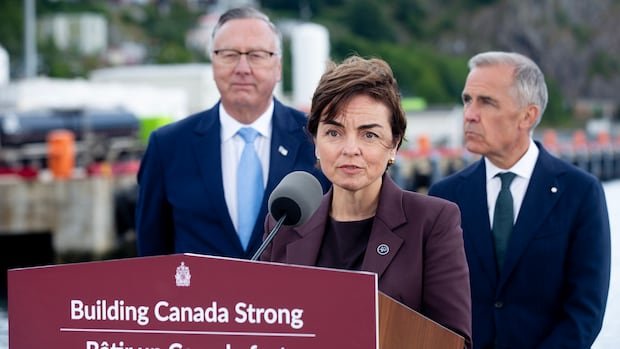


Prime Minister Mark Carney visited St. John’s to unveil a new accord concerning Churchill Falls and additional power initiatives in Labrador, accompanied by N.L. Premier Tony Wakeham and Quebec Premier Christine Fréchette. This agreement, regarded as the largest clean energy investment in North American history, is estimated at almost $70 billion, with $10 billion in federal financing from Ottawa. The funds will be allocated to enhance and expand the Churchill Falls generating station, develop the Gull Island hydroelectric project, construct transmission lines, and establish a 2,000 megawatts onshore wind energy project in Labrador. These enhancements will elevate the current generating capacity of Churchill Falls to the extent of powering all the residences in Toronto, Montreal, and Vancouver collectively.
The framework announced on Monday will remain in effect until March 2027, pending the final signing of the agreement. The involved parties aim to finalize the deal by year-end, although the upcoming provincial election scheduled for October 5 could potentially result in a change of government before the agreement is officially sealed.
Under the terms of the agreement, Quebec would gain access to over 10,000 megawatts, representing more than a quarter of Hydro-Québec’s current total output. In contrast, the previously rejected 2024 Churchill Falls Memorandum of Understanding offered a maximum potential of 7,200 megawatts. The electricity generated at Churchill Falls is set to be sold to Quebec at an average rate of 6.2 cents per kilowatt-hour, potentially leading to savings of $200 billion over the agreement’s duration.
Yvan Cliche, an energy sector expert at the Université de Montréal, hailed the agreement as a significant milestone for Quebec, emphasizing its benefits for both the energy sector and consumers by enabling Hydro-Québec to maintain low rates.
For Fréchette, the agreement signifies a pre-election victory and an opportunity to showcase her economic acumen. Describing the deal as a partnership that secures Quebec’s energy future for the next half-century and generates numerous job opportunities, she pledged to ensure the agreement’s formalization if her party retains power.
The Innu nations Matimekush-Lac John and Uashat mak Mani-utenam, situated in Quebec’s Côte-Nord region, issued a joint statement expressing their lack of consultation and emphasizing the project’s historical ties to their traditional lands. The statement stressed the necessity of their participation and consent for any Churchill Falls project agreement.
As the election campaign approaches, opposition parties have criticized Fréchette’s timing in finalizing the deal, with concerns raised about the long-term implications and the potential electoral motivations behind the agreement. Various parties have voiced skepticism and highlighted the need for a thorough analysis before ratification. Fréchette countered these criticisms by questioning the opposition’s alternative proposals and reiterating the economic benefits and job creation potential of the agreement for both Newfoundland and Quebec.