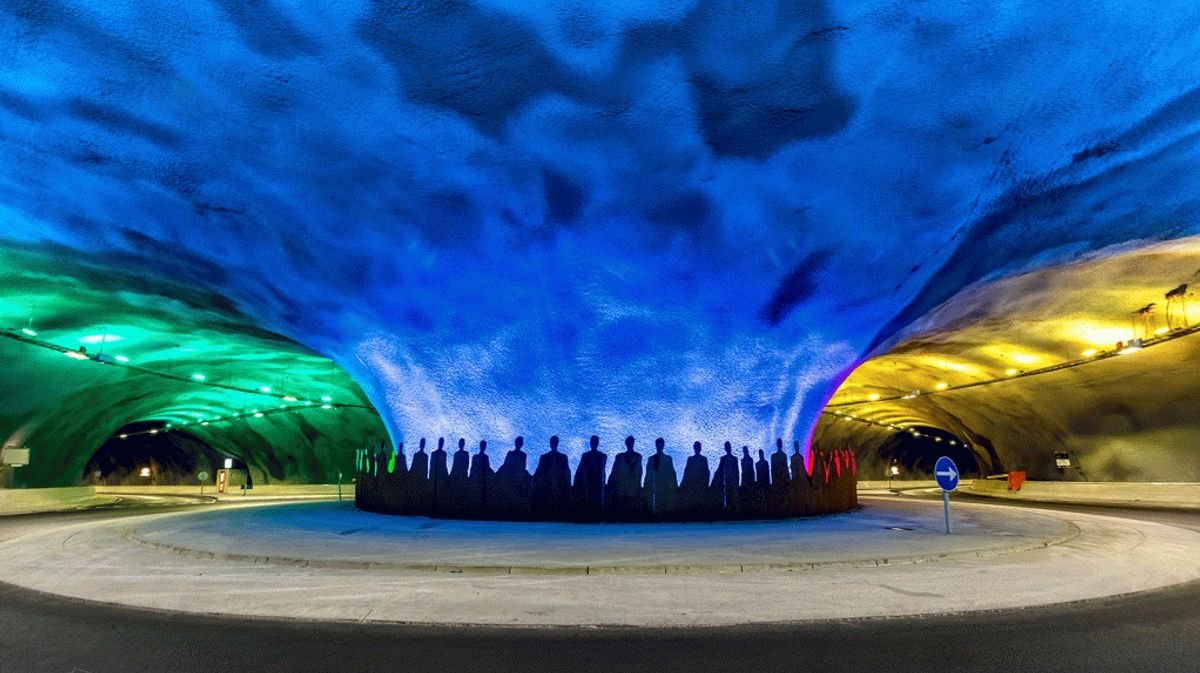


Nestled in the Atlantic Ocean lies the world’s sole underwater roundabout, affectionately known as the jellyfish roundabout. Situated within a tunnel called Eysturoyartunnil, this vibrant traffic circle connects two of the largest islands in the Faroe Islands.
Serving as the Faroe Islands’ equivalent of the Eurostar, this subsea tunnel spans 6.9 miles, linking Streymoy Island to Eysturoy Island with an eight-minute drive. At its core, 72 meters beneath the ocean’s surface, lies the globe’s first underwater roundabout.
Adorned with colorful lights, the roundabout, resembling a jellyfish, has captured significant attention online. Road users describe an eerie ambiance within the tunnel, particularly as they navigate the roundabout featuring dynamic shades of blue, red, and green, with black silhouettes of faceless figures encircling it.
At the roundabout’s center stands a monumental illuminated natural rock pillar, a remnant from tunnel construction. Decorated by Faroese artist Tróndur Patursson, the pillar is encircled by an 80-meter steel sculpture depicting life-size figures holding hands symbolizing unity and collaboration.
Opened on December 19, 2020, the Eysturoyartunnil subsea tunnel network was completed in just four years, aiming to revolutionize Faroese society by enhancing connectivity between people, regions, and economies. This tunnel substantially reduces travel time between the Faroe Islands’ main cities, cutting the journey from Tórshavn to Klaksvik in half to approximately 35 minutes.
Constructed by the Faroese company Eystur- og Sandoyartunlar, this tunnel project represents the largest single investment in the Faroe Islands, amounting to around €260m (£230m). Motorists traversing the deep Atlantic tunnel must pay a toll fee of 75 Danish krona (£8.60) each way, automatically billed as cameras scan license plates. Anticipated revenue from the tunnel is earmarked for future tunnel projects on the islands.
“We anticipate that this new infrastructure will help distribute tourism benefits more evenly across the northeastern Faroe Islands,” stated Guðrið Højgaard, director of Visit Faroe Islands, “and potentially stimulate local businesses to cater more to visitors.”