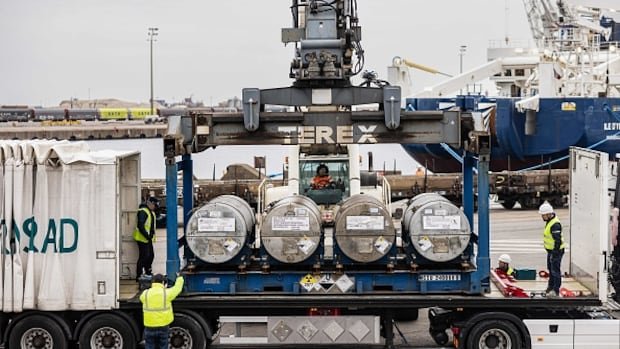


Amid the Russian military’s occupation of Ukraine’s largest nuclear plant and attacks on the country’s power infrastructure, both Europe and the United States continue to rely on Russian nuclear fuel for their electricity grids.
Westinghouse Electric, a Canadian-owned company, is among those receiving low enriched uranium (LEU) from Russia for commercial nuclear reactors in the United States, as per shipping data analyzed by CBC’s investigative program, the fifth estate.
Although the U.S. prohibited the import of Russian enriched uranium in August 2024 to reduce dependence on Russian materials and ensure a robust domestic fuel supply, waivers under the Prohibiting Russian Uranium Imports Act allow exceptions if alternative LEU sources are unavailable or if importation is deemed in the national interest. These waivers are set to expire by January 1, 2028.
In 2025, the U.S. imported 400 tonnes of low enriched uranium from Russia valued at about $1 billion USD, with major recipients including subsidiaries of Framatome, Global Nuclear Fuel Americas, and Westinghouse, according to a report by the Bellona Environmental Transparency Center in Lithuania.
Meanwhile, the European Union has no ban on Russian enriched uranium imports, and Canada has not imposed sanctions on transactions with Rosatom or Tenex, Russia’s state atomic energy corporation.
Experts emphasize the need for countries to reduce reliance on Russian nuclear supplies and terminate collaborations due to the ongoing conflict and threats to Ukraine.
Westinghouse, a significant player in the U.S. nuclear sector, processes enriched uranium into fuel pellets at its South Carolina facility before supplying them to commercial nuclear power plants. The company, partly owned by Brookfield Renewable Partners and Cameco Corporation, did not respond to inquiries regarding these matters.
As efforts to diversify nuclear fuel sources continue, Western nations are striving to lessen their long-standing dependency on Russian enriched uranium by boosting domestic production. Russia currently contributes around 44% of global enriched uranium and supplies a substantial portion used in the U.S. and Europe.
The process of transitioning away from Russian nuclear supplies is challenging, requiring a gradual shift towards alternative sources while maintaining connections to ensure a stable energy supply.
The article underscores the significance of supporting Ukraine and avoiding engagements with Russian state-owned nuclear entities to prevent strengthening enterprises associated with Moscow’s actions against Ukraine. Additionally, the importance of fostering energy security through diversified fuel sources is highlighted.
In conclusion, efforts to reduce reliance on Russian nuclear supplies and support Ukraine are vital for enhancing energy security and diminishing geopolitical vulnerabilities.