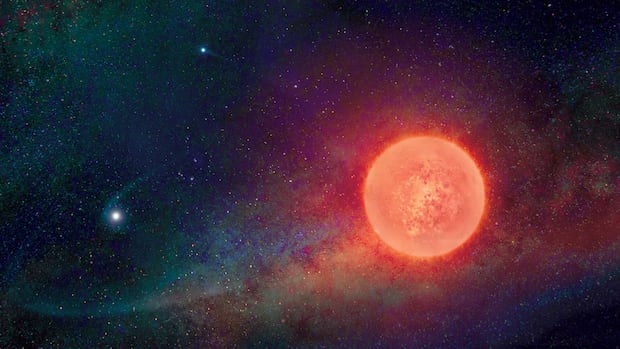


Located approximately 28 light-years from our planet, a unique star system known as IRAS 21500+5903 has captured the attention of astronomers.
For many years, scientists were aware of the existence of two stars that revolved around each other. However, during a search for exoplanets—planets that orbit stars outside our solar system—a group of researchers stumbled upon an unexpected finding: a third star in this system. Rather than being a binary star system, it turned out to be a triple-star configuration.
“It’s an unusual occurrence. It was an object that caused us some frustration,” stated Étienne Artigau, a researcher at the Trottier Institute for Research on Exoplanets (IREx) at the University of Montreal. “It wasn’t what we were aiming to find.”
The results of their research were published this week in the journal Astronomy & Astrophysics.
This star system features a red dwarf, a type of star that is prevalent in our galaxy, along with two more compact and heavy white dwarfs. One of these is situated about 1,000 astronomical units (the distance from the Sun to Earth) from the red dwarf, while the other is located just two astronomical units away, comparable to the distance from the Sun to Mars.
The inner white dwarf orbits the red dwarf, while the outer white dwarf revolves around the entire pair.
An unusual neighbor
It is quite astonishing that this third star had evaded detection for so many years.
“It’s strange that no one has identified this system, which suggests that there might be other oddities right next to us,” Artigau remarked. “It’s not right next door, but it’s just down the road, merely a block away in our stellar neighborhood.”
When a star of low to medium mass reaches the end of its life cycle, it first expands into a red giant before finally leaving behind a dense, small white dwarf. This process is what will eventually occur with our Sun in about five billion years.
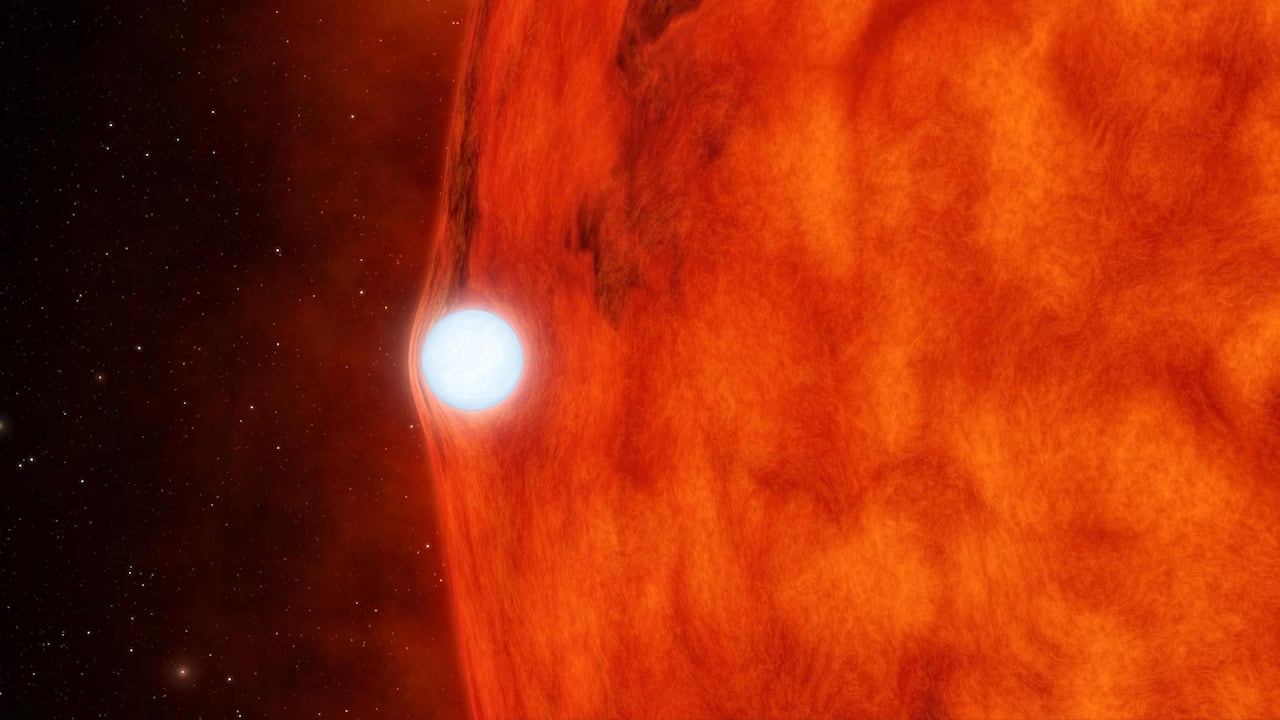
This artistic representation illustrates an ultra-dense dead star, known as a white dwarf, passing in front of a small red star. (NASA/JPL-Caltech)
While investigating for exoplanets in this system, the international team of astronomers—led by the University of Montreal—utilized an instrument called SPectropolarimètre InfraROUge (SPIRou) at the Canada-France-Hawaii Telescope in Maunakea, Hawaii. This tool detects exoplanets by measuring minute variations in a star’s velocity, caused by orbiting planets.
However, the red dwarf was exhibiting unexpected behaviors, with velocity shifts nearing 16 kilometers per second—an enormous deviation.
Initially, they speculated it could be a brown dwarf, a type of substellar object with a mass around 75 times that of Jupiter.
Yet, that explanation still did not add up.
More peculiarities
The unusual velocities were so significant that they disrupted Artigau’s calculations.
“At one point, we thought, let’s figure this out. Clearly something was off with that object. So, I adjusted the code,” he explained. “Then we concluded, let me calculate this brown dwarf. Nope, that doesn’t fit either.”
This became quite the puzzle.
-
Are we alone? Institute searching for alien signals is using a new way to answer that age-old question
-
Astronomers think they’ve captured a planet forming around a host star — something never seen before
Eventually, they realized that the source of the disturbances was a high-mass… object. Yet, it remained invisible.
Could it be a black hole? A neutron star? A white dwarf?
The team then turned to the Gemini North telescope, also situated on Maunakea. With high-resolution imaging from its ‘Alopeke instrument—a specialized high-speed camera—they identified what they were seeking: a faint companion star, a white dwarf, orbiting closely around the red dwarf.
Here’s where it becomes even stranger.
Before transforming into a white dwarf, this star would have expanded into a red giant. As it grew larger, its orbit would have been so close to the red dwarf that they likely interacted. Often, these stars engulf the red dwarf, or the two could even merge, but that didn’t occur here.
There’s more to this mystery.
The inner white dwarf should be spiraling inward toward the red dwarf, yet it maintains a stable orbit.
It’s possible that the more distant white dwarf is somehow maintaining this orbit’s stability, although the exact mechanism is still unknown, warranting further investigation.
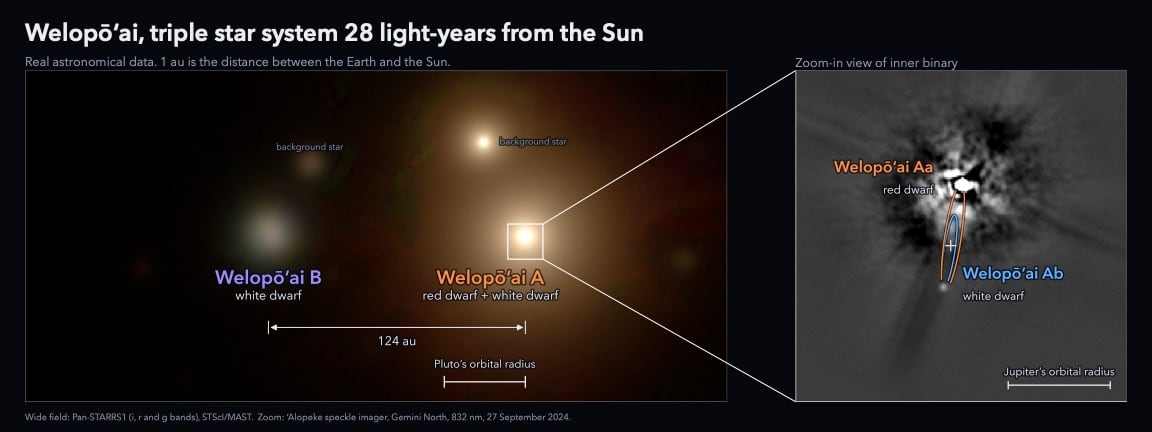
The left image displays the two components of the system: Welopō’ai A, a red dwarf and white dwarf pair in close orbit, and Welopō’ai B, a more distant white dwarf. The right image offers a close-up view of the inner pair and their orbital trajectories. (Pan-STARRS1/STScI/MAST, left, International Gemini Observatory/NSF NOIRLab, right. Graphical construction by Étienne Artigau & Heidi White (UdeM/IREx))
“We’re asserting it cannot exist,” Artigau noted. “Of course, it does exist. It’s right there.”
Paul Delaney, a professor emeritus of physics and astronomy at York University in Toronto, hypothesizes that the more distant white dwarf may have once been much closer to the other two.
“When planetary systems form, one of the common phenomena is migration,” he stated. “I suspect that they were once relatively close together and engaged in some gravitational interactions, leading to the further white dwarf being much nearer during its earlier stages.”
To further add to the peculiarities, astronomers estimated the system to be around 10 billion years old, older than our solar system, which is 4.6 billion years old, and its stars are rich in metals. Typically, older stars are known to be metal-poor.
“It’s intriguing, and we are unsure if it holds significance. It could just be an anomaly in the stellar population,” Artigau remarked.
Continuing the search for exoplanets
The researchers have given this system the Hawaiian name Welopō’ai, combining “welo” meaning an inherited family trait, and “pō’ai,” which signifies an orbit or circular path. Thus, the name translates to “path of family traits.”
The popular book and Netflix adaptation 3 Body Problem explores a triple-star system and its potential impacts on nearby planets, particularly for civilizations that may have evolved there.
One term used in the series to describe the triple-star system is “chaotic,” which influences the pace at which civilization can develop.
This scenario presents a long-standing physics challenge. Two-body systems are predictable. However, introducing a third body complicates the dynamics significantly. Body A exerts force on Body B and Body C, while Body C influences both Body A and Body B, leading to perpetual changes in their motions and forces.
Although the researchers did not identify an exoplanet, Artigau confirmed that the search continues.
“This system is so unusual that Atanas Stefanov, one of the co-authors, is applying for further observational time to search for planets around the red dwarf,” he mentioned.
Whether a planet exists there or if an extraterrestrial civilization could thrive on a world within a triple-star system remains uncertain.
For Artigau, the introduction of new findings was an exhilarating experience.
“I find it fascinating,” he expressed. “Unexpected elements in research are enjoyable.”