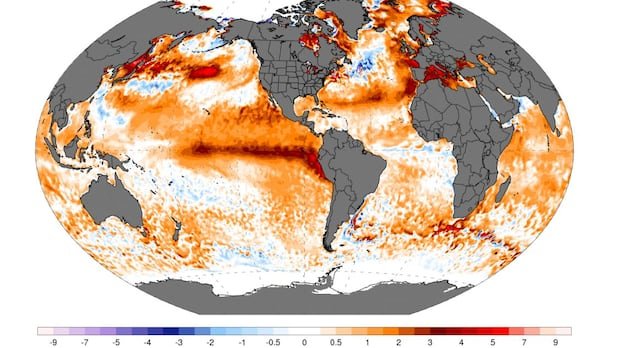


The much-anticipated El Niño has arrived and is already proving to be significant. Earlier this year, climate experts predicted the development of an El Niño in the central Pacific region. Over time, various models indicated the possibility of a strong or even “super” El Niño, though it was cautioned that certainty was still premature.
In its June monthly update, the U.S. National Oceanic and Atmospheric Administration (NOAA) confirmed the presence of warmer conditions in the specific Niño 3.4 region of the Pacific Ocean, meeting the criteria for an El Niño with temperatures exceeding 0.5 C above average. Currently, ocean temperatures in this region are nearly 2 C above average, a record high for this time of year.
Zeke Hausfather, a climate scientist at Berkeley Earth, noted that these conditions are bordering on a very strong or potentially “super” El Niño, with temperatures already surpassing 2 C above average by early July.
El Niño and La Niña are part of the natural El Niño Southern Oscillation (ENSO) cycle, with El Niño bringing warmer temperatures to the Pacific region. Forecasts suggest that the peak of this El Niño event may occur in October, with some models leaning towards November or December for the highest intensity.
The last powerful El Niño occurred in 2015-2016, with a temperature anomaly of approximately 2.75 C. The rapid transition from La Niña to El Niño this year has raised questions about the underlying causes and potential impacts of such a rapid shift within a year.
There are concerns about the impact of this El Niño on food security in tropical regions and on winter conditions in Canada, which may lead to milder temperatures but also drier conditions, posing risks for wildfires in Western Canada. Hausfather emphasized the seriousness of preparing for the potential impacts of this El Niño event on various sectors, highlighting its significance for agriculture, ecosystems, and oceanic environments.