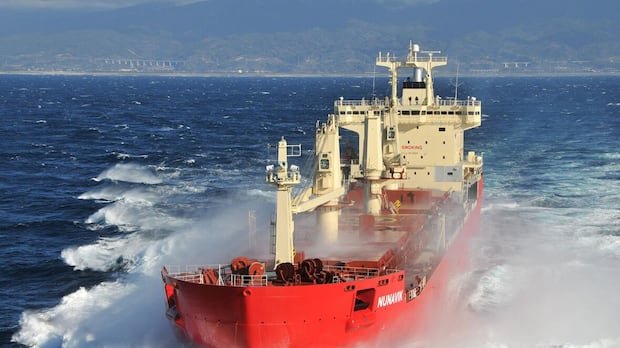


Premier Wab Kinew has revealed that an estimated $70 to $80 billion will be required for the construction of a Port of Churchill expansion, incorporating an offshore liquefied natural gas terminal in Hudson Bay. Recent studies indicate that ice-resistant freighters could navigate Hudson Bay safely beyond the usual four-month shipping season of the Port of Churchill. However, the studies caution that fully loaded natural gas tankers, designed to withstand sea ice, would face challenges maneuvering within the narrow entrance of the existing port.
A feasibility study conducted by Arctic Gateway Group, the owner of the port and Hudson Bay Railway, concluded that substantial dredging, infrastructure modifications, or the establishment of an offshore loading facility would be necessary to accommodate such vessels in Churchill. Comparatively, constructing a liquefied natural gas terminal at Kitimat, B.C., took $40 billion over a 12-year period.
Kinew expressed optimism following the release of new studies suggesting the feasibility of shipping liquefied natural gas through icy waters. He dismissed concerns that Indigenous and Arctic communities would oppose gas shipments as they would oil transport through Hudson Bay, highlighting the perceived lower environmental impact of liquefied natural gas compared to oil.
The studies propose that year-round shipping in Churchill could commence immediately using ice-hardened freighters, even as some ice is expected to persist in the bay under potential global warming scenarios. Kinew emphasized that current technology, together with the use of affordable icebreakers and ships, could transform Churchill into a year-round port.
While acknowledging the challenges posed by the dynamic ice environment of Hudson Bay, Fednav, in collaboration with Arctic Gateway Group, outlined the potential for extending Churchill’s shipping season and achieving year-round access in the future. Further field studies and assessments are recommended to address uncertainties related to ice conditions.
Arctic Research Foundation estimated the cost of ice-hardened vessels suitable for Hudson Bay to range from $100 million to $410 million, significantly less than specialized icebreakers. A separate study led by University of Manitoba experts projected the persistence of ice in Hudson Bay even with a five-degree Celsius rise in average global temperatures by the end of this century, a scenario diverging from current expectations of a 3.4-degree Celsius increase.
Kinew intends to pitch the Port of Churchill expansion to investors in Toronto, emphasizing the economic potential of the project. The proposed expansion, spearheaded by Arctic Gateway Group, aims to enhance infrastructure at the port and railway, enabling higher payloads and improved facilities.
Despite the positive outlook, uncertainties remain regarding federal funding and community support for the expansion project. Manitoba Opposition Leader Obby Khan criticized Kinew’s announcement for lacking concrete details on financing, timelines, and Indigenous engagement, pointing out potential challenges posed by climate change on the Hudson Bay Railway.
In conclusion, the Port of Churchill expansion project holds promise for transforming Churchill into a year-round shipping hub, but key stakeholders must address challenges related to infrastructure, climate change, and community engagement to ensure its success.