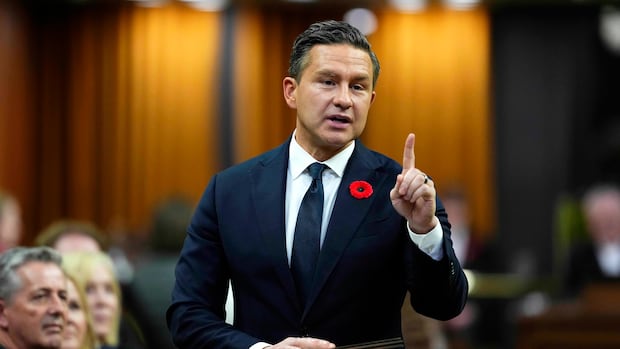


Conservative Leader Pierre Poilievre is taking aim at a significant aspect of the Carney government’s recent budget, contending that the suggested $15-million capital gains exemption for the sale of qualifying shares from Canadian firms is too limited, leaving out essential businesses.
“Honestly, I can’t discern who actually qualifies,” Poilievre remarked during an interview on Rosemary Barton Live that aired Sunday morning. “I suspect it might be no one, and qualifying for that exemption seems to require you to stand on one foot while counting backwards from a thousand with your finger on your nose.”
In the 2026 federal budget, presented on Thursday, the Canada Growth Incentive does not include businesses in sectors such as agriculture, fishing, forestry, finance, insurance, utilities, real estate, food and accommodation, arts, recreation, and entertainment.
Consequently, Poilievre described it as “insignificant and irrelevant,” claiming it complicates the existing system further. The budget anticipates this measure will generate $715 million in tax relief over the next four years, starting next fiscal year.
Prime Minister Mark Carney’s Liberal administration is promoting the incentive as a means to motivate Canadian entrepreneurs to establish valuable companies in Canada. Early-stage employees may receive a larger share of equity as part of their compensation, and investors would benefit from improved after-tax returns for supporting the business.
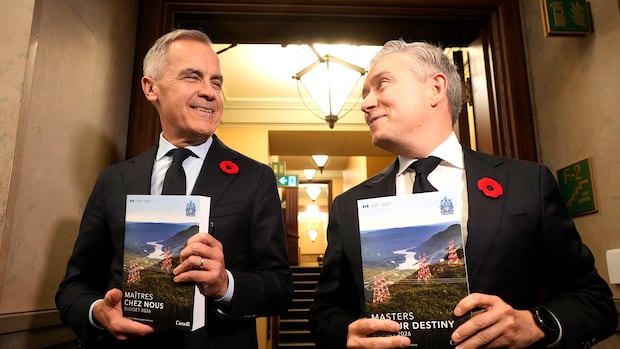
The Carney government’s second budget outlines over $150 billion in expenditure aimed at attracting investment, expediting nation-building projects, enhancing housing, and addressing the affordability crisis. The NDP claims it favors the wealthy, while Conservatives label it a ‘credit card budget Canadians cannot afford.’
The budget describes the $15-million exemption as “substantial,” as it allows founders to retain almost 96 percent of the company’s value upon exit, compared to the current 71 percent.
This initiative has been positively received by some business organizations, including the Council of Canadian Innovators, which represents 175 high-growth companies in the nation. The organization asserts that the incentive will create an environment that helps firms attract talent and expand.
Poilievre did show support for Carney’s productivity mega-deduction, which is projected to cost around $36 billion over five years, stating that any tax reduction on investments is a “positive” development.
However, Poilievre’s strategy would enable businesses and individuals reinvesting their capital gains within Canada to fully defer tax payments.
“This would bring back the hundreds of billions of dollars in investments that companies and individuals currently have parked overseas. I believe that would act as economic rocket fuel. It would be much simpler than the proposals put forth by Mr. Carney and the Liberals,” the Opposition leader stated.
Poilievre mentioned that he personally suggested this idea to Carney and urged the Prime Minister to “adopt my idea because we urgently need job-creating investments in Canada.”
NDP critiques affordability initiatives
The New Democrats have capitalized on the budget’s tax reductions for new business investments, contending that the measures aimed at affordability for Canadians are comparatively inadequate. In a video statement released on Thursday, NDP Leader Avi Lewis stated, “If you’re a billionaire, this budget feels like Christmas has arrived early.”
After Finance Minister François-Philippe Champagne delivered the budget in the House of Commons, Lewis acknowledged that it allocates new resources to combat homelessness, but remarked that it “continues to shovel more funds to the wealthiest CEOs and investors, with the expectation that everyone will benefit from it. This approach has proven ineffective.”
Lewis also highlighted a chart in the budget illustrating the distribution of announced spending. According to the chart, $98 billion is categorized as “Growth and Investment,” while $48 billion is designated for “People.”

In an unexpected encounter, Finance Minister François-Philippe Champagne joins NDP Leader Avi Lewis’s interview on Power & Politics, leading to a debate about the federal budget.
In a discussion, Champagne emphasized that affordability is a primary concern and highlighted that the budget enhances Canada’s grocery benefit, prolongs the suspension of the federal excise tax on fuel, and incorporates additional measures for dental care and pharmacare.
“We are allocating two-thirds of the additional revenue we receive toward growth and investments to stimulate economic growth,” the finance minister explained. “Simultaneously, we have earmarked one-third for direct support to individuals.”
Poilievre criticized the government’s approach to borrowing, asserting that “government debt does not foster investment. It leads to inflation, stagnation, and ultimately, failure.”
-
From groceries to tax credits, how much is in the federal budget for your wallet?
-
7 takeaways from the Carney government’s 2nd budget
“We need to remove the barriers that government imposes on Canadians so that we can achieve genuine free-market growth that can cover expenses and provide food on the table,” the Conservative leader argued.
Champagne informed host Rosemary Barton that it will take some time before the tax cuts and productivity initiatives proposed by the government yield tangible benefits for ordinary Canadians, but he remains optimistic about the long-term effects of the budget.
“This will ultimately strengthen us and enhance our resilience,” Champagne concluded.