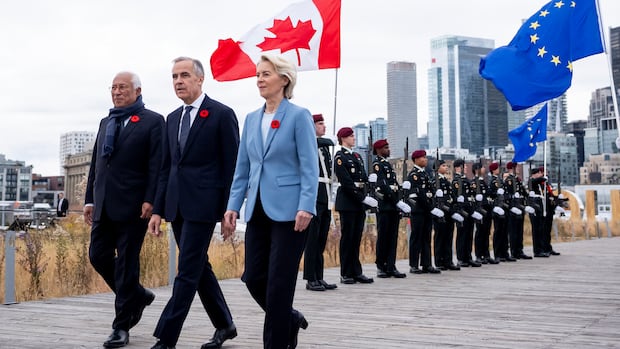


Prime Minister Mark Carney announced that Canada is aiming to become the first associate member of the European Union, marking his most explicit remarks on the subject following a meeting with the leaders of the bloc in Montreal this week.
However, the specifics of what this membership would entail and its associated costs remain uncertain.
During this year’s Canada-EU summit, officials from Canada and Europe finalized several negotiations and initiated a range of new commitments aimed at strengthening their alliance. Nevertheless, the conversation surrounding the designation of their enhanced partnership has somewhat eclipsed the collaborative efforts between Ottawa and the 27-member bloc, especially since some EU members oppose the notion.
“We are striving for the closest possible partnership, short of accession due to our geographical position, with Canada becoming the European Union’s first associate member,” Carney stated in his closing remarks.
“In the upcoming months, we will outline the nature, scale, and details of this membership format.”
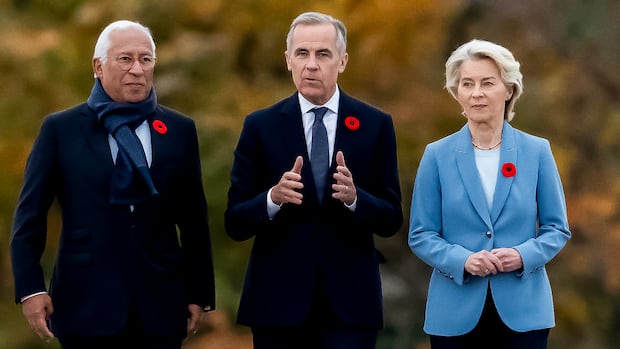
Standing alongside the presidents of the European Commission and European Council in Montreal, Prime Minister Mark Carney remarks that Canada and the EU are ‘working towards the deepest possible partnership, short of accession… with Canada becoming the European Union’s first associate member.’
Previously, Carney had refrained from using the term “associate member,” maintaining that the specific terminology was inconsequential.
However, by Friday, he introduced a timeline into the discussion, stating that negotiations are expected to conclude in June, coinciding with his participation in European Council meetings.
He further mentioned that he, along with European Commission President Ursula von der Leyen and European Council President António Costa, would meet with the College of the European Commissioners and Canada’s federal cabinet in March.
Von der Leyen was the first to propose the idea of making Canada an associate member—a status that currently does not exist within the bloc—in a speech last month, and she has been actively advocating for this initiative despite resistance from some members, particularly Germany.
No discussion on costs
Following the news conference, a Canadian official, speaking off the record, was unable to specify what legislation would be required in Canada and among EU member states.
“It’s merely a concept,” the official remarked, highlighting the absence of a formal process to attain associate membership.
When asked about the potential costs associated with joining as an associate member, Carney responded, “we don’t see this as a transaction; we view it as a unification.”
Although von der Leyen, Costa, and Carney are all advocating for the title, it is far from finalized. EU member states will need to vote, and Carney has indicated that the new partnership with the EU will be subject to debate and a vote in Canada’s Parliament.
“Canada is undoubtedly the most European of the non-European nations,” Costa commented on Friday morning.
Canada-EU sign agreements
Disagreement over the partnership’s designation was evident in the drafting of the joint statement released at the summit’s conclusion.
According to sources familiar with the proceedings, the term “associate member” was omitted from the draft due to opposition from certain members, with Germany reportedly indicating it was a non-negotiable issue. Consequently, the final statement referred to “an ever-closer association of Canada to the EU, short of full membership itself.”
Beyond the title, the document clearly outlines that Ottawa and Brussels have much to collaborate on as they advance what is being labeled the “alliance for the future.”
On Friday, the two parties announced the conclusion of negotiations with the European Investment Bank to support investments in essential Canadian resources, particularly critical raw materials, along with another agreement focusing on countermeasures against anti-competitive practices.
They also completed negotiations on a digital trade agreement between the EU and Canada aimed at enhancing legal clarity and facilitating cross-border data exchanges, as well as finalizing an agreement granting Canadian researchers and businesses access to European supercomputers.
Additionally, Canada will participate in an EU initiative to provide aid to Ukraine, known as the Ukraine Support Loan.
Regarding future actions, both sides have consented to broaden opportunities for Canadians and Europeans to study, work, and engage in research. There is also a commitment to initiate discussions on establishing international connectivity between Canada, Europe, and Asia through new subsea cable infrastructure.
The document includes pledges in numerous other areas, including the Arctic, combating foreign information manipulation, and enhancing cooperation on artificial intelligence (AI) security and safety.
It also advocates for reforming the World Trade Organization rather than replacing it, along with taking further actions on border security and addressing climate change.
“At its core, this signifies sovereignty,” Carney stated. “Increased resilience and the ability to collectively withstand challenges.”
However, the financial implications of all these new initiatives remain unclear.
Finance Minister François-Philippe Champagne avoided queries on Thursday, suggesting Canadians should focus solely on “opportunities.”
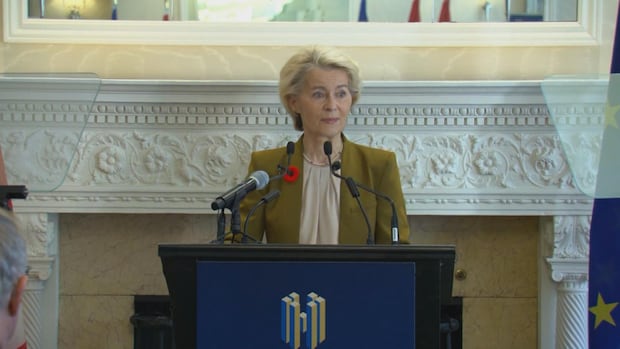
After the term ‘associate membership’ for Canada was reportedly excluded from a proposed joint statement on Wednesday, European Commission President Ursula von der Leyen revisited the idea on Thursday, proposing a partnership ‘that comes closer to membership than anything we’ve done before.’
Opposition Leader Pierre Poilievre criticized the summit, stating it was characterized by “grand statements” but lacked tangible outcomes.
“There was considerable discussion at the summit about aligning Canada with the extreme European taxes, debt, immigration, and anti-oil and gas policies that have left parts of Europe in financial distress,” he posted on social media on Friday.
“Does any of this alleviate your mortgage payments, rent, grocery costs, or gas prices back here in the real world? Absolutely not.”
Carney emphasizes EU’s commitment to democracy
The summit was promoted as a means to strengthen relationships with allied leaders in light of the unpredictable and unstable administration of U.S. President Donald Trump.
While the three leaders in Montreal shared common objectives, shifting political dynamics in Europe could challenge that unity, particularly in France and Germany—both influential nations within the bloc.
In France, far-right presidential candidate Marine Le Pen’s National Rally is leading in polls ahead of the spring 2027 election. Le Pen, who advocates for strict immigration controls, has criticized the EU-Canada trade agreement.
In Germany, the far-right and isolationist Alternative for Germany (AfD) party continues to gain traction in both regional parliaments and national opinion polls.
When asked Thursday about concerns regarding working with a potentially different political landscape, Carney praised the EU’s commitment to democratic principles.
-
Far right gains ground in Europe as Canada pivots from Trump to EU
-
Carney says Canada is working to become an ‘associate member’ as he hosts EU leaders in Montreal
“One of Europe’s strengths is its commitment to democracy, freedom, and a fundamental belief in the rule of law. There will always be varying governments and political ideologies in Europe,” he told reporters.
“Over the decades, the European Union has evolved, strengthened, and has been enriched by the democratic processes of its member nations.”
Carney also minimized the notion that he was seeking to secure agreements with the EU prior to the French election cycle. “We’re not linking this to any political timeline, but rather to the core principles of what they provide … for Canadians,” he stated.
When asked earlier this week if the summit might provoke a backlash from Trump or right-wing leaders in Europe, a senior Canadian government official informed reporters that the meeting was not aimed at any particular individual but reflected the profound interests shared between Canada and the EU.