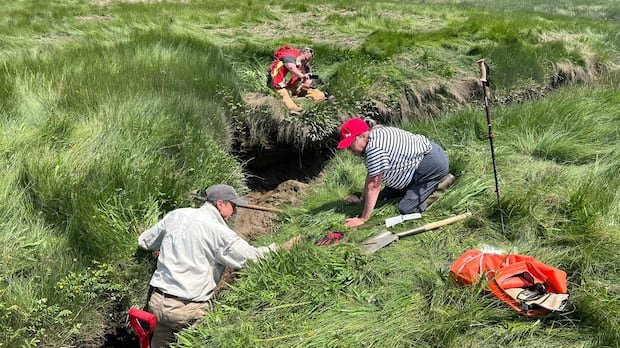


On a river in southwest Nova Scotia, a historical detective is unraveling forgotten remnants of North America’s history. Allains River, previously known as Lequille River, meanders as a tributary of the Annapolis River, coursing from the province’s interior to what is now Annapolis Royal.
Four centuries ago, this river hosted one of the earliest industrial ventures post-colonization: a flour mill constructed in 1607 and later destroyed by fire in 1643. The mill’s precise location remained a mystery for ages until an amateur historian from the U.S., along with a team of researchers and archaeologists, has made significant progress in pinpointing its whereabouts. This endeavor sheds light on Nova Scotia’s history of colonization, interactions, and the enduring presence of the Mi’kmaw people.
Mark Borton, a writer from Connecticut spearheading the quest for the Poutrincourt gristmill, expressed the site’s profound significance. The need for a flour-producing gristmill arose in 1605 when a fortified fur-trade post, dubbed Port Royal by Samuel de Champlain, was established on the Annapolis Basin. Borton highlighted the crucial role of the mill in providing flour, as bread accounted for a substantial portion of the French diet at the time.
Inspired by Champlain’s 1607 map depicting the mill’s location, Borton embarked on this historical pursuit during a visit to the Maritimes in 2018. By analyzing Champlain’s map alongside contemporary geographical features, Borton identified a potential site for the mill, leveraging tools like Google Maps to scrutinize the landscape.
Collaborating with the Nova Scotia Museum, Borton delved further into the investigation, leveraging lidar mapping technology to uncover traces of dikes dating back to the early 17th century. This summer, Borton and the museum’s team collected samples for radiocarbon dating from these dikes, enhancing the credibility of their findings.
Additionally, Borton enlisted the expertise of archeologists at Kwilmu’kw Maw-klusuaqn and Saint Mary’s University to delve deeper into the historical significance of Allains River. Professor Jonathan Fowler from Saint Mary’s highlighted the project’s alignment with their research on the French-Mi’kmaq interactions, emphasizing the rich historical tapestry present at Allains River.
Fowler’s team plans to employ ground-penetrating radar to further explore the mill site, aiming to unravel more layers of the shared landscape’s history. As the project progresses, it serves as a unifying force, bringing together diverse communities and preserving the multicultural heritage embedded within Nova Scotia’s historical sites.