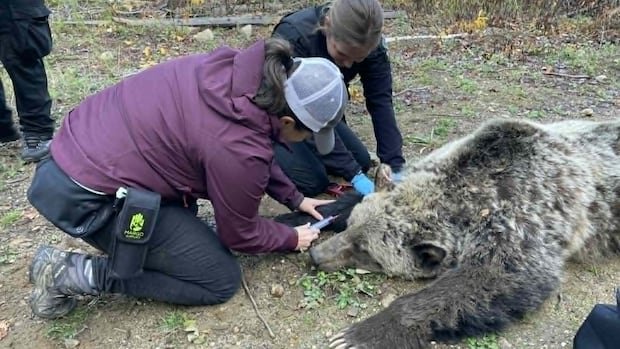


The former community co-ordinator of Wildsafe B.C. Nelson is urging for action following what she describes as “numerous shortcomings at various levels” that resulted in the demise of a grizzly sow and two of her three yearlings recently. Lisa Thomson expressed her sorrow over the incidents and disclosed her resignation from the position in response to the bear killings.
The four bears had captured public attention during their travels in the Nelson region. The mother bear was euthanized after being relocated but returning to the West Kootenay community. One of the yearlings was put down by the B.C. Conservation Officer Service (BCCOS) due to being unsuitable for relocation because of age and health concerns. Another yearling was also euthanized after being relocated and later found near Christina Lake consuming garbage.
Andrew Milne, deputy chief of the BCCOS, explained that the decision to euthanize the bear was made as it had become habituated to humans, displayed no fear towards them, and accessed unnatural food sources, leading to a situation where the bear would not leave the area.
Thomson acknowledged the protocols involved in such decisions but expressed her difficulty in accepting them in this instance. She highlighted that the bears had been frequenting the Nelson area due to the presence of feral fruit trees, emphasizing that the issue cannot be solely addressed by relocating the bears.
She advocated for collaborative efforts among residents, local authorities, and businesses to implement bear-smart practices in their communities. Thomson cited the example of Canmore and Banff in Alberta, where centralized, animal-proof community bins have replaced individual curbside trash containers to mitigate wildlife interactions.
Thomson emphasized the need for residents to actively prevent wildlife attractants and discourage bears from becoming comfortable in human-populated areas. She stressed the importance of establishing clear boundaries and employing tactics to deter bears from lingering near human establishments.
Additionally, she clarified misconceptions about Wildsafe B.C.’s role, stating that the organization operates independently to educate the public and is not directly affiliated with the BCCOS. The fourth yearling of the grizzly sow was relocated successfully and is currently under monitoring after briefly appearing in Christina Lake.
In the aftermath of the bear incidents, Thomson called for a reevaluation of existing practices and emphasized the importance of proactive measures to promote peaceful coexistence between wildlife and humans.