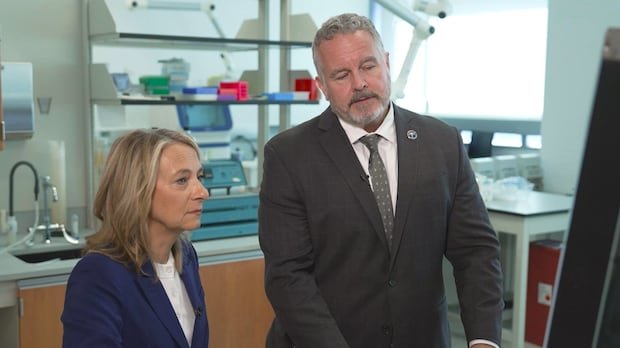


In a laboratory in Manhattan, forensic experts in white lab attire are diligently working to fulfill a pledge made 25 years ago. They are extracting DNA from numerous human remains recovered post the World Trade Center terrorist attacks, aiming to match them with samples from personal items provided by victims’ family members. The key change lies in the scientific methods utilized to extract DNA and the evolving forensic investigative techniques that were non-existent in 2001.
Mark Desire, the assistant director of forensic biology at the New York City Office of the Chief Medical Examiner, expressed the emotional significance of being able to identify and reunite a loved one with their family after years of scientific advancements.
Out of the 2,753 individuals who perished at Ground Zero, 40% remain unidentified, including around 10 of the 24 Canadian victims. Recently, the lab accomplished its first identification of previously unknown remains using a groundbreaking method, with the family opting to keep the woman’s identity private.
This innovative technique merges DNA testing with genetic genealogy, utilizing family tree research conducted by the New York City Police Department to enhance the identification process. Dr. Jason Graham, the Chief Medical Examiner of New York, described it as a new frontier likely to lead to further identifications.
Monica Iken-Murphy, whose husband died in the World Trade Center collapse, finds renewed hope in this development. She emphasized the emotional importance of identifying the remains, unlike receiving mere items like rings or cards belonging to the deceased.
Desire, a rookie scientist during the 9/11 attacks, vividly recalls the harrowing experience at Ground Zero and the imperative to preserve and identify all victims’ remains. The excruciating process of excavating and preserving remains has been ongoing, with challenges posed by various destructive elements at the site.
Scientific advancements have enabled the extraction of more DNA from bone fragments, though bone remains the most challenging material for DNA extraction. The lab faces difficulties in testing badly burned samples, risking the loss of material before a match can be found.
The new technique involves sending DNA from unidentified remains to an external lab for genomic sequencing, followed by genealogical searches by the police to confirm relationships through DNA testing at the medical examiner’s office. The office urges families to provide samples to facilitate more matches.
Despite these efforts, some families opt not to know if a match is achieved, deeming it too traumatic. Personal decisions like these reflect the complex nature of grief experienced by families of victims. Abigail Carter, a Canadian expat who lost her husband, has found her unique way to honor his memory, showcasing the individualized responses to the tragedy of 9/11.