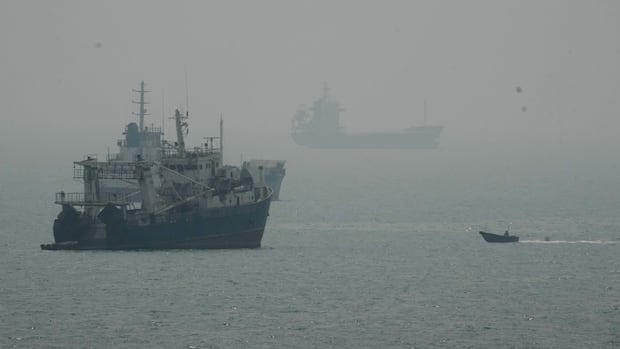


An Iranian cargo ship was hit early Sunday near Qeshm Island in the Strait of Hormuz, according to reports from Iranian state media, leading to a delay in Tehran’s plans to inform neighboring nations about its disputed shipping management strategies in the strait.
The incident, which reportedly resulted in one fatality and four injuries, refocused attention on the strait amid escalating threats to regional shipping last week following the capture of an island in the Bab al-Mandab Strait in the Red Sea by Iran-supported Houthi rebels.
The Qeshm governor, as quoted by Iran’s state-run IRNA news agency, attributed the attack to a “terrorist enemy.” The U.S. military has not issued an immediate statement, even as it has previously targeted Iranian-flagged vessels during its blockade of Iranian ports and now faces renewed threats from Iranian ballistic missiles aimed at its naval forces.
Located approximately 22 kilometers from the port city of Bandar Abbas, Qeshm Island plays a crucial role in Iran’s assertion of authority over the Strait of Hormuz.
Just hours prior to the attack, Iran’s leadership remained resolute. President Masoud Pezeshkian expressed on social media, “Our people cannot be coerced into submission. Iran will not capitulate.”
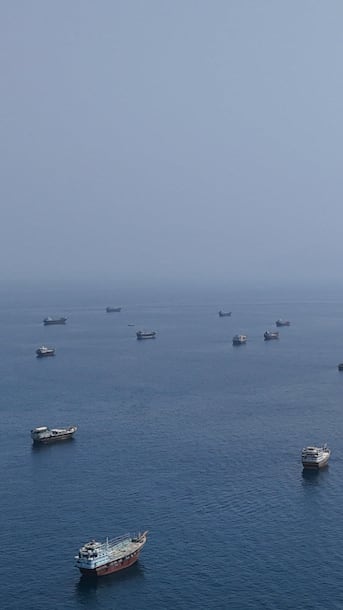
U.S. Central Command indicates it has conducted new strikes on Iran, claiming these actions were in response to Iran’s plans to deploy sea mines from rockets into the Strait of Hormuz. Andrew Chang explores the potential for Iran to utilize missiles for underwater mine deployment.
(Photo credits: The Canadian Press, CAT-UXO, Reuters, Adobe Stock, and Getty Images)
U.S. President Donald Trump contradicted this, asserting on Sunday that Iran “desperately wants a deal” and is “constantly reaching out.” Trump made these statements while at his golf course in Doonbeg, Ireland, where he was participating in a tournament.
When asked by a reporter whether the U.S. military had targeted the Iranian cargo vessel earlier on Sunday in the Strait of Hormuz, Trump replied, “I don’t want to comment.” He then boarded Air Force One to return to Washington.
Iran aims to brief region on strait
Iran had announced that foreign ministers from neighboring countries were scheduled to gather on Monday in Oman to discuss shipping management efforts by Iran and Oman, situated on the opposite side of the strait. However, Oman’s foreign minister, Badr Albusaidi, mentioned on X that the meeting had been postponed “for the sake of consensus.”
Mohammad Ali Bak, a spokesperson from Iran’s Foreign Ministry, noted that Iran and Oman chose to delay the discussions “at the request of certain regional nations,” according to IRNA’s report on X.
Ship traffic continues to be low in the Strait of Hormuz, as attacks persist in what was previously regarded as an international waterway before the onset of war initiated by the U.S. and Israel on February 28.
On Sunday, the United Kingdom Maritime Trade Operations reported that a vessel was struck by a projectile while passing through the strait, although it was unclear if this incident was related to the attack reported by Iran off Qeshm. The monitor indicated that a significant fire had erupted, prompting local authorities to evacuate individuals on board.
The U.S. maintains that a significant amount of oil is still being exported, as its military continues to guide ships along the coast of Oman, despite the threat of attacks.
Prior to the postponement of the meeting in Oman, only Iraq had publicly confirmed its participation, while Bahrain declared it would not attend, citing a lack of diplomatic ties with Tehran.
Since the beginning of the conflict, Iran has shown interest in charging fees for transit through its waters. It has stated that vessels heading into the Persian Gulf would navigate through Iranian waters, while the outgoing route would partially traverse both Iranian and Omani waters.
There had been some hope in the region regarding the planned meeting, with expectations that Gulf nations might use it to establish a unified response to a war that they did not instigate. For months, they have dealt with Iranian strikes that Tehran claims target U.S. military positions within their territories.
On Sunday, Iran’s president mentioned having a “productive discussion” over the weekend with a senior official from the United Arab Emirates during a global summit of major developing nations.
Iran has launched thousands of missiles and drones at the Gulf nation, a close ally of the U.S.
Pezeshkian noted that he had a meeting with Sheikh Khaled bin Mohamed bin Zayed, the crown prince of Abu Dhabi, during his attendance at the BRICs summit in New Delhi.
He stated, “We discussed matters of mutual concern to move beyond the past, look ahead, and explore how we can collaboratively build the future.” His remarks were broadcast live on Iranian state television.