


In a recent address, Prime Minister Mark Carney asserted that “Canada fuels American growth,” citing the nation’s natural gas exports to the U.S. as a key example. This raises an intriguing question: What might occur if Canada decided to stop sending shipments to its southern neighbor?
To date, energy commodities such as oil and natural gas have not been leveraged in the ongoing trade tensions between Canada and the U.S. This notion is contentious, with Alberta Premier Danielle Smith consistently opposing it, while Ontario’s Doug Ford argues that all alternatives should be considered.
“The narrow merchandise trade deficit that the U.S. experiences is largely due to its substantial energy purchases from Canada,” Carney stated on Saturday, the day after trade negotiations between Canadian and American representatives collapsed in Washington.
“[Canada supplies] 99 percent of their natural gas imports, 85 percent of their electricity imports, and 60 percent of their crude oil imports.”
The term “imports” carries significant weight in this context, particularly regarding natural gas. The U.S. Energy Information Administration (EIA) reports that U.S. imports from Canada averaged 8.6 billion cubic feet daily in 2025, accounting for nearly all non-domestic supplies in the U.S. However, this figure represents only a small fraction of total U.S. natural gas consumption—around eight percent based on EIA’s data.

U.S. President Donald Trump’s tariffs against Canada have had far-reaching consequences in unexpected areas. B.C.-based Santa ornament-carver Dave Francis is one such individual affected.
According to Dulles Wang, director of Americas gas and LNG at the energy research company Wood Mackenzie, that figure might actually be as low as five percent, per his firm’s estimates.
“It’s relatively minor,” he informed CBC News.
Natural gas pipelines span North America in a complex network, crossing the Canada-U.S. border at around two dozen points. This commodity is vital for heating homes, generating electricity, and supporting industries, making it essential for the daily lives of millions.
Enbridge, located in Calgary, stands as North America’s foremost natural gas supplier. In 2024, the company finalized a $19 billion series of transactions to acquire three U.S. utilities.
-
Carney says he doesn’t ‘see the value’ in using energy as leverage in U.S. trade talks
-
Fact-checking the White House statement of facts about Canada
“Natural gas flows across the borders continuously, every day, at all hours. And this isn’t just a one-way trade,” Wang explained.
“The U.S. imports Canadian supplies, primarily for the western and Midwest markets. Concurrently, the U.S. also exports gas back into Canadian markets, especially on the eastern front.”
Although Canadian natural gas exports to the U.S. may seem small compared to U.S. domestic output, Wang emphasizes the significance of where these exports occur.
“You won’t find Canadian gas traveling to Texas, as Texas produces more gas than it requires,” he pointed out.
“In areas like the Pacific Northwest, which includes Seattle, Oregon, and Northern California, over 90 percent of the gas comes from Canada.”
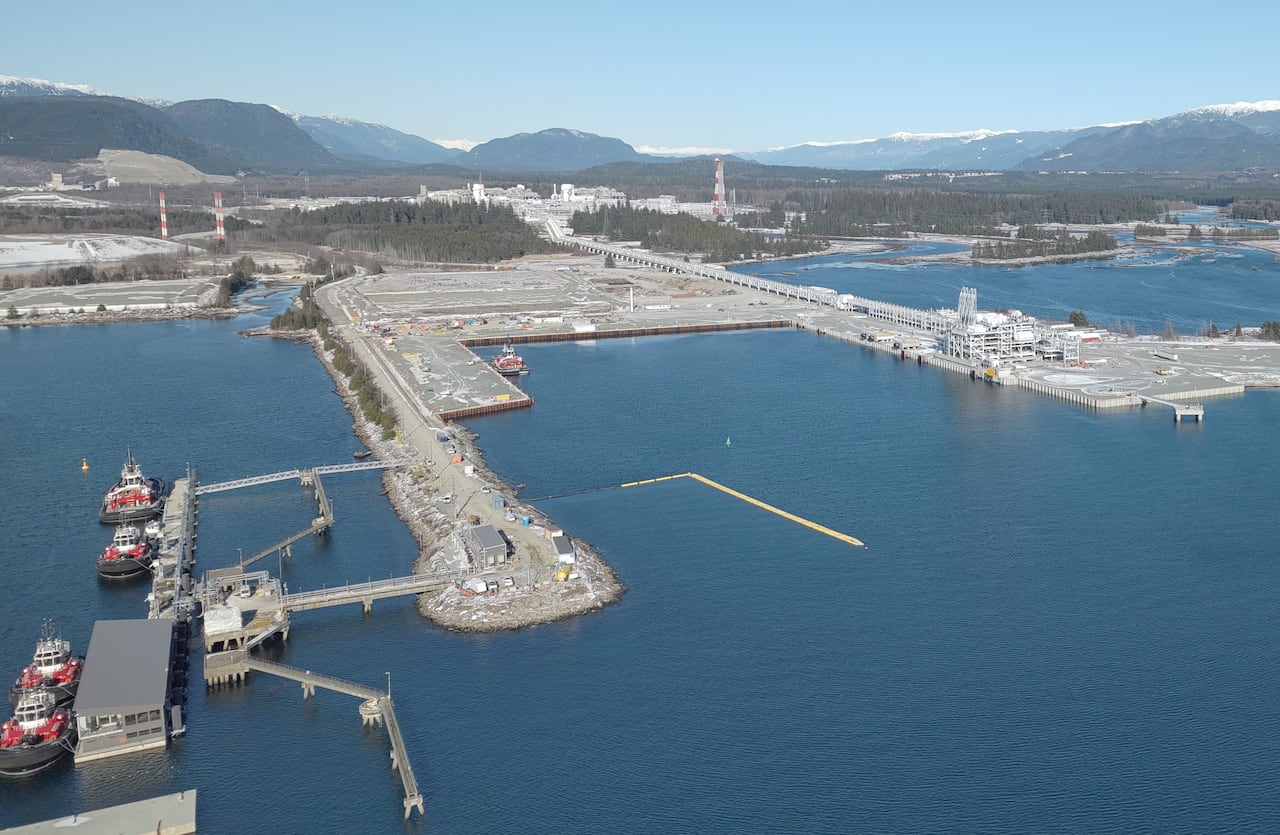
The LNG Canada facility in Kitimat, B.C., began sending liquefied natural gas to Asian markets just last year. The federal government is working to broaden Canada’s energy exports beyond the U.S. (LNG Canada)
Fueled by the increasing demand for artificial intelligence, these regions have experienced a boom in data center construction supported by American tech giants such as Amazon, Google, Microsoft, and Meta. These energy-intensive facilities often rely on natural gas as a primary power source to complement renewable energy.
“If natural gas supplies are cut off, not only will people face freezing temperatures, but your data centers will also cease operation,” Wang remarked.
Canada would be ‘shooting itself in the foot’
Wang asserts that stopping natural gas exports to the U.S. would inflict significant harm on Canada’s industry. He anticipates that excess supply trapped in Canada would lead to a drastic drop in prices as storage facilities reach their limits.
“We would see a severe economic toll if gas exports to the U.S. were halted,” Wang stated. “Canada would be effectively ‘shooting itself in the foot’ by severing ties with its primary buyer and causing prices to crash.”
“There are no benefits for anyone in this scenario,” he added.
The federal government of Canada is seeking to attract more buyers outside the U.S. Last year marked the first shipments of liquefied natural gas from the LNG Canada facility in Kitimat, B.C., destined for Asian markets.
The government’s Major Projects Office is supporting the next phase of this initiative, along with the floating Ksi Lisims LNG export facility that is pending construction approval off the B.C. coast.
“A strong commitment is essential to advance these projects; otherwise, we risk remaining stranded or overly reliant on the U.S. market,” Wang stated.