

U.S. President Donald Trump has directed the Pentagon to reduce planned joint military exercises with South Korea. Trump justified this decision by stating that South Korea declined to support efforts to denuclearize Iran and highlighted his positive relationship with North Korea’s leader, Kim Jong-un.
In a social media post, Trump criticized the cost and perceived hostility of the upcoming exercises, which he believes send the wrong message to North Korea. Despite acknowledging that it was too late to cancel the exercises, Trump instructed Secretary of Defense Pete Hegseth to significantly scale back the joint military drills.
Trump also mentioned that he had asked South Korea to join the U.S. in addressing Iran’s nuclear ambitions, but South Korea declined the invitation. This move to reduce the exercises is not unprecedented, as Trump had previously expressed opposition to the military drills during his first term.
While South Korea’s Defence Ministry confirmed that the exercises proceeded as planned, the country’s presidential Blue House stated that it was reviewing Trump’s decision. The Blue House expressed hope that the friendly relationship between the U.S. and North Korean leaders would foster meaningful dialogue and contribute to peace and stability on the Korean Peninsula.
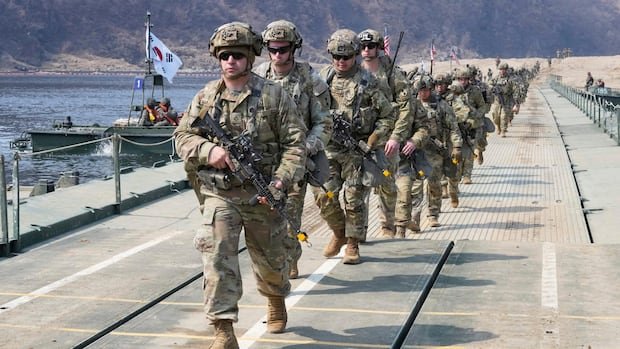
The joint military exercises involving 18,000 South Korean soldiers were designed to enhance readiness against potential threats from North Korea. The U.S. military emphasized that these exercises reinforced the alliance’s role in regional security and underscored the commitment between the U.S. and South Korea to defend their territories.
Following North Korea’s recent ballistic missile testing, Trump’s decision to scale back the exercises faced criticism from Democratic Sen. Mark Kelly, who described the move as short-sighted. North Korea, in response, issued a warning against the U.S. and South Korea, characterizing the military drills as provocative and destabilizing.
The decision to reduce the joint military exercises reflects Trump’s efforts to prioritize diplomatic relations with North Korea, despite previous tensions and disagreements. North Korea’s continued weapons testing activities and aggressive rhetoric signal ongoing challenges in the region.