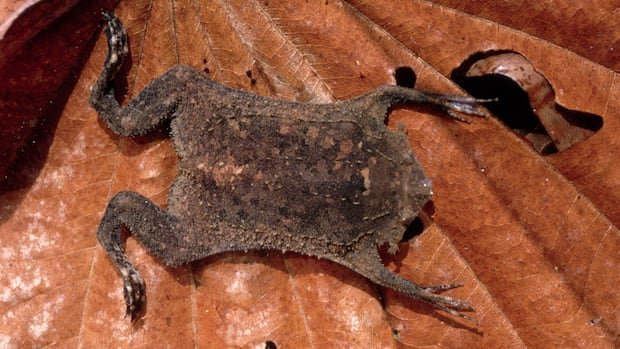


Researchers in California have made a fascinating discovery about the unique abilities of the Surinam toad. Despite its unusual appearance and limited vision, this toad is a skilled hunter capable of capturing prey with incredible speed. Scientists have long been puzzled by how the toad detects its prey in murky waters, given its poor eyesight and small eyes.
A recent study conducted by Duncan Leitch and his team at the University of California, Los Angeles, has shed light on this mystery. The toad, also known as the star-fingered toad, uses its fingertips to sense the subtle movements of water caused by nearby prey. These fingertips are equipped with specialized touch organs that resemble the high-resolution sensors found in the human eye, allowing the toad to identify the size and proximity of potential prey.
Through the use of a powerful microscope, researchers observed that each frog’s fingertips contain 128 tiny lobes covered with numerous papillae, which enhance touch sensitivity. Despite making up only a small portion of the frog’s skin, these lobes house a significant number of touch-sensitive nerves. The toad’s brain allocates a disproportionately large amount of space to processing sensory information from its fingertips, highlighting the importance of this sensory mechanism in its hunting strategy.
This finding is particularly significant as it suggests a sophisticated sensory strategy in a relatively simple brain structure, challenging previous assumptions about brain complexity and sensory processing in vertebrates. The study underscores the evolutionary convergence between frogs and mammals, indicating that both groups have evolved similar solutions to maximize sensory input from specific body regions.
Lea Randall from the Wilder Institute in Calgary emphasizes the relevance of these findings in understanding vertebrate evolution and brain development. By unraveling how frogs have adapted their brain function to optimize sensory information, researchers gain valuable insights into the evolutionary mechanisms that have shaped vertebrate sensory systems over millions of years.