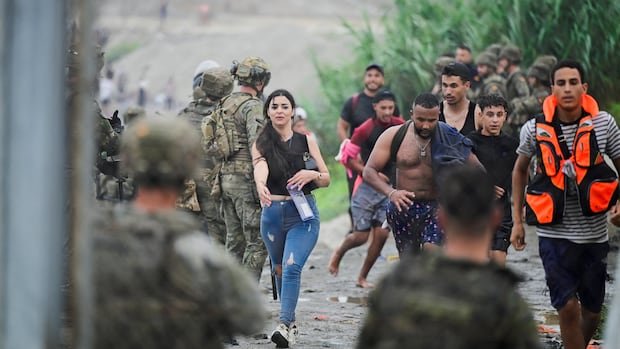


Spain and Morocco have strengthened the border fence of a Spanish enclave to deter mass crossings after a significant influx of people by sea and land. A reported 57 individuals have lost their lives, with approximately 60,000 individuals entering Ceuta in recent days, according to Juan Jesus Vivas, the leader of the Spanish enclave in North Africa.
By 6 p.m. local time on Friday, an estimated 48,300 migrants had voluntarily returned to Morocco, as reported by Spain’s Interior Ministry. The sudden surge of individuals crossing into Ceuta, a small Spanish-held territory bordering Morocco, has caused concern and division within Europe. France announced heightened border checks with Spain, while Italy threatened to suspend Spain from the European Union’s open border scheme.
Moroccan authorities at the gates of Ceuta utilized water cannon trucks, batons, and tear gas to push back individuals attempting to cross the border. The aftermath of clashes revealed charred vehicles, signaling the intensity of the situation. Spanish authorities aim to expedite the expulsion of those who entered illegally, despite certain legal constraints surrounding immediate expulsions.
Spanish Prime Minister Pedro Sanchez condemned the mass crossings as a violation of Spain’s territorial sovereignty, urging Morocco to intensify efforts to curb the outflow of people. Ceuta and Melilla, two Spanish autonomous cities in northern Morocco, serve as the European Union’s sole land borders with Africa, witnessing sporadic surges in migration attempts.
Various factors, including a recent ruling by Spain’s Supreme Court limiting immediate returns of migrants intercepted at sea, may have contributed to the surge. Migrants often swim from Moroccan towns like Fnideq to reach Ceuta, covering approximately five kilometers, or attempt the crossing from closer locations like Belyounech.
Migration remains a contentious issue in Europe, with heightened security measures being implemented. France announced a fivefold increase in police presence on its border with Spain, while Germany and Italy expressed concerns over border security. President Donald Trump of the U.S. commented on the situation, likening the crossings to an invasion.
Despite the challenges posed by illegal crossings, Spain advocates for the economic contributions of immigrants, supported by long-term data. The government has even offered mass amnesties to integrate individuals into society. Tensions have escalated within the EU, with Italy criticizing Spain’s citizenship grants and Spain seeking solidarity from its partners.