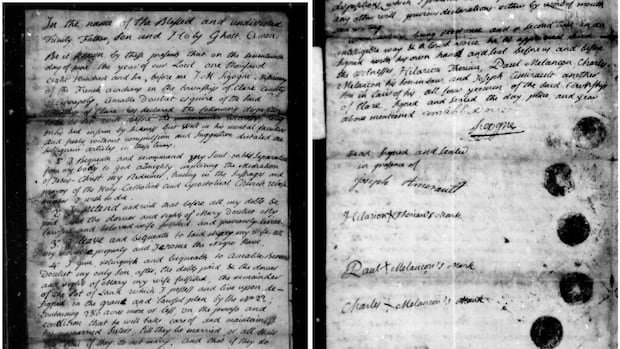


Hilarion Thériault, at the age of 71, made the decision to draft a will, a rare occurrence among Acadians in the 19th century. This was because many Acadians had little property to pass down due to the loss of land and homes during the Acadian deportation. Moreover, Roman Catholics were not allowed to own property in the province until the 1780s, leading to struggles in obtaining land titles.
Colby Gaudet, a post-doctoral researcher at Dalhousie University, examined Thériault’s will and 23 others from the small Acadian community of Clare, Nova Scotia, to explore how families managed legal and religious practices related to death. Gaudet described this act as both resistance and adherence to existing Anglophone property norms while emphasizing the Roman Catholic faith.
Thériault’s will emphasized the importance of settling debts, seeking reparations for any wrongdoings, and ensuring peace for his family. Maurice Basque, a historian at l’Institut d’études acadiennes at Université de Moncton, highlighted the social ostracization faced by Acadians when these wills were written.
Following the 1755 Acadian deportation, the Crown claimed Acadian lands and distributed them among settlers from New England, aiming to replace the Acadian population over decades. Despite some Acadians returning later, they faced challenges in reclaiming their rights, including restrictions on holding positions of power through oath tests.
Gaudet noted that language barriers existed for Acadians as all county judges overseeing wills were Anglo-Protestant. These wills, composed by priest Jean-Mandé Sigogne, acted as a vital link between the Acadian families and the judicial system.
The wills analyzed by Gaudet belonged mostly to community leaders like Thériault, who held prominent roles in the parish. Despite societal stigmatization, these wills reflected the deep integration of Catholicism into daily life, with specific Catholic details and references to saints.
Furthermore, the wills shed light on the relationships between Black individuals and Acadians. For instance, Amable Doucet’s will revealed the passing of a Black slave named Jerome to his wife, highlighting the complex social dynamics within the community.
Overall, the study of these wills provides valuable insights into Acadian history, legal practices, and religious customs, showcasing the resilience and cultural heritage of the Acadian community in Clare, Nova Scotia.