

A researcher is investigating the impact of an invasive insect and the chemicals utilized to combat it on the fauna residing in ancient hemlock forests. Hemlock woolly adelgid (HWA) has been causing significant damage to forests in southwestern Nova Scotia for nearly ten years. To curb its spread, various entities including Parks Canada, the province, local groups, and private landowners have been employing insecticides, particularly imidacloprid and dinotefuran.
Mathilde Christjansen, a master’s student at Mount Allison University in Sackville, N.B., highlighted the lack of knowledge concerning the effects of woolly adelgid and the insecticides on other species. She emphasized that imidacloprid, designed to impact insect nervous systems, has been detected in the brains of other animals like fish and tadpoles.
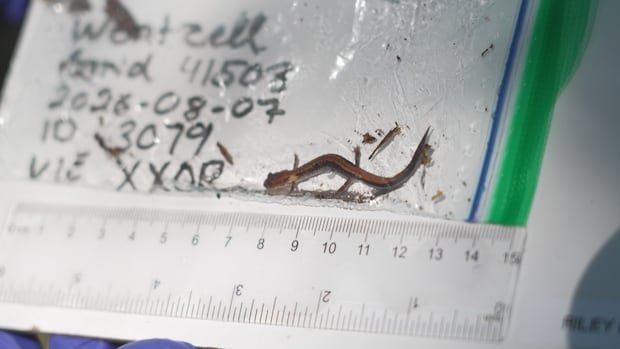
Instead of individually studying all species across hemlock forests, Christjansen’s team is using the eastern red-backed salamander as a bioindicator species to gain insights into the ecosystem’s health. These salamanders are sensitive to environmental conditions and pollutants, making them a valuable indicator of overall forest well-being.
For their study, researchers placed coverboards in forests last year to provide habitat for salamanders. They conducted periodic surveys to count and measure the salamanders underneath these coverboards. Some forests under study are treated with either or both insecticides, while others remain untreated.
Additionally, behavioral tests were conducted on the salamanders found, such as gently prodding them to observe their response to predation and flipping them over to assess their agility. The findings from these tests will help determine the impact on salamander populations and, by extension, the broader ecosystem health.
The study also examines how dying hemlocks influence salamanders. Chris Edge, a supervisor and scientist with the Canadian Forest Service, explained that the demise of hemlock trees disrupts the unique habitat conditions they provide, affecting salamander populations dependent on moist environments.
The project, conducted in collaboration with multiple organizations including Mount Allison University and the Canadian Forest Service, is part of a comprehensive investigation into forest health in Eastern Canada. Christjansen plans to continue her study until next year, analyzing the collected data and field videos to further understand the implications of HWA and insecticides on the environment and species like the eastern red-backed salamander.