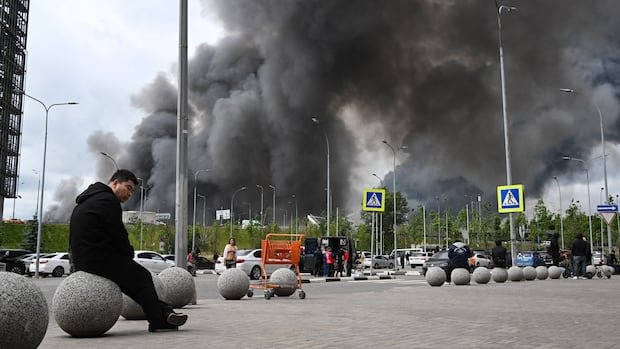


Last week, Moscow witnessed a significant drone attack launched by Ukraine on the Russian capital amid Russia’s full-scale invasion in 2022. The attack caused widespread disruption, with numerous flight delays and cancellations, and a major oil refinery on the city’s outskirts repeatedly targeted and set ablaze. Ukrainian President Volodymyr Zelenskyy warned of retaliation, stating, “If Ukraine burns, so will Moscow.”
The intensified strikes have brought the conflict closer to home for Russians, disrupting their daily routines and undermining their sense of security. Analysts suggest that prolonged attacks could heighten domestic tensions, potentially impacting Russian President Vladimir Putin’s hold on power or prompting him to escalate the conflict further.
Historian Anne Applebaum highlighted the impact of the drone strikes on Muscovites, noting that it was their first encounter with such extensive campaigns since the war began. The attacks are seen as a catalyst for shifting attitudes among influential figures who influence Putin’s decisions.
Despite the visible damage caused by the strikes, footage of the attacks was not aired on Russian news channels, and residents were not alerted to the impending danger. This lack of information has left Moscow residents anxious and uncertain about their safety.
In addition to Moscow, other Russian cities have also been targeted. Ukraine’s military struck an electronics plant in Voronezh, Russia, responsible for producing missile components. Furthermore, drones caused power outages in Crimea and targeted energy infrastructure in central and southern Russia, leading to fuel restrictions in the Crimean Peninsula.
The ongoing attacks have instilled fear and uncertainty among affected communities, with residents expressing concerns about their safety and the lack of protection. Reports suggest a decline in Putin’s approval ratings, indicating growing discontent among the Russian populace.
While some pro-war figures have criticized Putin’s handling of the conflict, it does not necessarily signify a shift in support for the war itself. Ukrainian journalist Eugene Slavnyi emphasized that despite internal criticisms, many Russians continue to back the ongoing conflict.
Exiled opposition activist Mikhail Khodorkovsky highlighted the potential consequences of dwindling support for Putin, indicating that the president’s reliance on security forces could increase if public backing diminishes. However, he believes that the oligarchs in Russia are closely aligned with Putin’s regime and are unlikely to turn against him.
As discontent grows internally, experts warn that Putin may resort to harsher measures to maintain control, potentially leading to further escalation and violence against civilians. The mounting pressure on Putin, coupled with his desire to project strength, raises concerns about the future trajectory of the conflict.