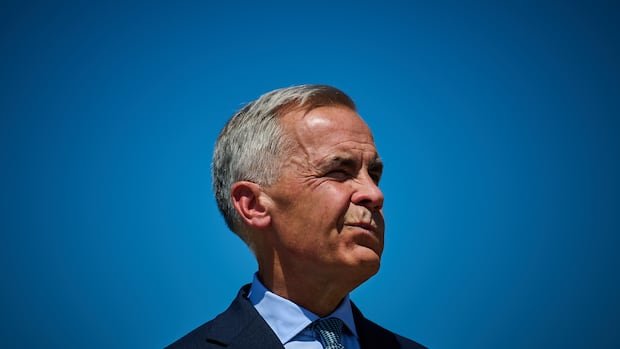


Prime Minister Mark Carney has described the ongoing last-minute discussions with the United States to prevent the enforcement of new tariffs this week as “delicate” and “intense.” Carney intends to engage in talks with his American counterpart within the next 48 hours to secure a mutually acceptable agreement. During a press briefing in St. John’s on Monday, Carney refrained from divulging specific details of the negotiations to avoid President Donald Trump’s threatened Section 338 tariffs on Canadian goods.
“We are currently engaged in sensitive and high-pressure negotiations, and this is not the appropriate forum for public discourse,” Carney stated in French. “We are entering these discussions from a position of strength.”
When asked about potential retaliatory measures if an agreement is not reached, Carney asserted his readiness for any scenario, stating, “I have plans in place for all eventualities.” Carney and Trump conversed on the phone on Monday afternoon regarding the ongoing trade discussions, as confirmed by Audrey Champoux, a spokesperson for the Prime Minister, who did not provide further details on the call.
Over the past few weeks, Canada-U.S. Trade Minister Dominic LeBlanc and Canada’s chief trade negotiator, Janice Charette, have engaged in multiple discussions with U.S. Trade Representative Jamieson Greer to not only avert the planned Section 338 tariffs but also reduce the existing Section 232 tariffs on industrial products such as steel, aluminum, autos, and lumber in exchange for certain Canadian concessions. LeBlanc and Charette participated in their lengthiest meeting with Greer and U.S. Commerce Secretary Howard Lutnick on Monday, lasting approximately one hour and 45 minutes.
Sources familiar with the negotiations anticipated that this ministerial meeting would be the final one, although its status post-meeting remains uncertain. Another source mentioned the possibility of Canadian officials meeting with Greer before Carney and Trump’s scheduled discussion ahead of the tariff deadline on Wednesday, although no such meeting is currently arranged.
Following the meeting with Canadian officials, the American negotiating team was expected to convene with Trump. The negotiations are centered on the extent of benefits Canada can secure from the U.S. in exchange for its concessions. The U.S. is seeking the reinstatement of American liquor in Canadian stores and the elimination of Canada’s retaliatory tariffs on U.S. autos, alongside adjustments to the dairy sector’s quota allocation system.
Conversely, Canada is advocating for the withdrawal of the threatened Section 338 tariffs and substantial tariff reductions for sectors heavily impacted by U.S. tariffs. Greer has consistently expressed the U.S.’s reluctance to completely abandon its tariff structure.
Despite the challenges, Erin O’Toole, a member of the Prime Minister’s Canada-U.S. advisory committee, acknowledged some progress in negotiations with the Americans. O’Toole emphasized the importance of reaching a fair deal beneficial to Canadian workers and the economy, highlighting the need for mutually acceptable tariff rates and potential responsive measures if the U.S.’s tariffs are enforced. O’Toole cautioned against the negative repercussions of tariff conflicts on both economies and workers, underscoring the importance of averting such scenarios.