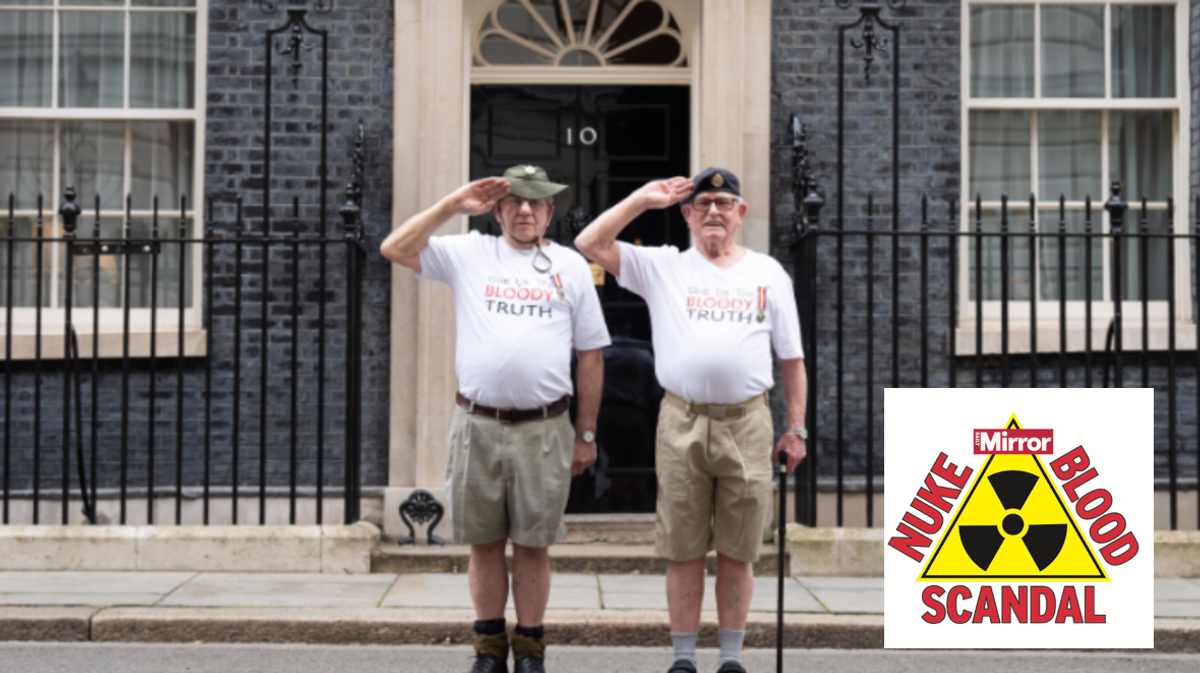


A government study investigating the causes of death among veterans exposed to radiation intentionally omitted evidence showing over 1,000 troops had received radiation doses. This crucial data was disregarded by scientists examining cancer rates in veterans who participated in nuclear bomb tests during the Cold War.
The study’s final report concluded that there was no link between the veterans’ deaths and the nuclear weapon trials, attributing any cancers to mere chance. However, it took 70 years for an updated version of the research to establish a statistically significant connection between serving at nuclear test sites and subsequent mortality.
Despite this, the study still could not definitively determine if cancers were directly linked to radiation exposure, as a substantial number of documented radiation doses were inexplicably removed from the study at its inception.
Advocates are now urging the Ministry of Defence to discontinue reliance on the discredited study, which faced scrutiny when officials were found to have influenced the conclusions. They plan to address this issue in an upcoming meeting with Prime Minister Keir Starmer scheduled for early in the New Year.
Alan Owen from the advocacy group LABRATS remarked, “Veterans always suspected the study was deceptive, and now we have concrete evidence. The MoD can no longer use this flawed science to conceal its wrongdoing. We anticipate discussing this with the Prime Minister and urging him to acknowledge the victims of these human radiation experiments.”
The disclosure stems from a summary of dose records known as “the Blue Books,” kept by the Atomic Weapons Establishment and classified as state secrets. Access to these records was restricted to AWE personnel with high-level security clearance, and repeated requests to view them were denied.
After a 14-month Freedom of Information battle, the Mirror finally acquired a copy of the Blue Books. The documents revealed that 14,290 servicemen participated in trials in Australia and the Pacific over more than a decade, with 6,053 having recorded radiation doses by atomic scientists.
Although many of these doses were considered low, it was understood at the time that any level of radiation could be harmful. However, when the government initiated a cancer and mortality study in 1985, 1,031 recorded doses were excluded from the analysis.
Official data now indicates that 20,956 men participated in the tests, but only 5,423 doses were recorded. Consequently, the number of veterans whose deaths were examined increased by 47%, while the count of those exposed to radiation was reduced by 17%.
John Folkes, a former RAF aircraft technician, recounted his experience participating in atomic cloud sampling missions during Operation Buffalo in Australia in 1956. Despite having his radiation dose recorded along with 967 others at Buffalo, nearly a third of these doses were excluded from the study, leaving only 786 for analysis.
John, now 89 and residing in Broadstairs, Kent, shared his battle with prostate cancer and post-traumatic stress, reflecting on the false sense of security provided by the authorities. He expressed disbelief at his survival amidst these circumstances.
<p class="Paragraph_paragraph-text__PVKlh