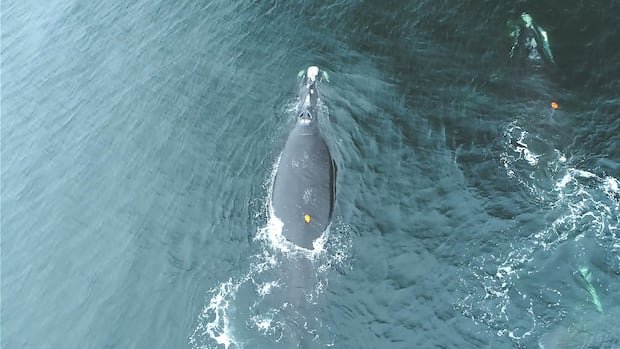


A recent research study has discovered that critically endangered North Atlantic right whales are now feeding closer to the surface of the ocean at night, which is increasing the likelihood of them being struck by boats. The findings were published in the scientific journal PLOS One earlier this month, shedding light on the nighttime feeding behavior of these whales and offering insights to prevent fatal collisions with vessels.
The study, led by Jay Kirkham, a PhD student at Dalhousie University in Halifax, collaborated with the U.S.-based non-profit Ocean Alliance to attach tags to 23 North Atlantic right whales in the Shediac Valley, an underwater valley in the southern Gulf of St. Lawrence. This valley serves as a feeding ground for a portion of the estimated 384-strong North Atlantic right whale population every summer.
Kirkham explained that the tags collected video footage and data on the whales’ movements and swimming directions. Observations during the day were used to train a machine learning algorithm to identify nighttime feeding behavior, revealing that the whales are feeding at a depth similar to that of large vessels at night, elevating the risk of collisions.
While these whales typically feed near the seabed during the day, they follow their food source, zooplankton, higher up in the water column at night. This behavior coincides with the paths of large ships passing through the area, creating a vertical overlap that increases the danger of collisions.
Collisions with vessels and entanglements in fishing gear are the primary causes of death among North Atlantic right whales. The study’s findings could help in shaping conservation efforts for the whales, with Transport Canada and Fisheries and Oceans Canada currently overseeing protective measures for the endangered species.
Fisheries and Oceans Canada highlighted that their efforts are primarily focused on preventing whale entanglements in fishing gear and enforcing seasonal fishing closures. The study’s outcomes are expected to aid in tailoring management strategies to safeguard North Atlantic right whales.
Transport Canada, on the other hand, implements speed restrictions and a vessel exclusion zone in the Shediac Valley during the summer to minimize the risk of collisions between boats and right whales. However, Kirkham noted that a significant portion of the tagged whales spent a quarter of their feeding time outside the exclusion zone, leaving them vulnerable to ship traffic.
Transport Canada stated that they employ a right whale surveillance program utilizing visual and audio detection tools to protect the whales from collisions. The department emphasized the use of acoustic monitoring systems and other technologies to enhance whale detection regardless of lighting conditions and to inform protective measures in the presence of whales.
The latest scientific research, monitoring data, and feedback from stakeholders are leveraged by Transport Canada to inform and refine their protection measures for North Atlantic right whales.