


According to a survey carried out by the provincial auditor general, several public servants in Nova Scotia with scientific knowledge claim they are being silenced and coerced into diluting environmental evaluations of onshore wind energy projects.
On Tuesday, Nova Scotia Auditor General Kim Adair unveiled these findings as part of an audit that recommended the government enhance its approach to environmental assessments for new projects.
Environmental assessments are performed by governments to allow scientists and other specialists to assess the effects of industrial operations and decide whether to proceed with mitigation measures.
However, the recent audit revealed that public servants accused the government of stifling the recommendations given by its own experts during these evaluations.
“For instance, individual respondents conveyed feelings of being ‘muzzled,’ instructed not to propose terms and conditions, or pressured to ‘modify or soften’ their feedback,” the report stated.
-
N.S. launches call for more onshore wind in final push to meet 2030 target
-
Nova Scotia approves plans for the province’s largest onshore wind farm
The office of the auditor general indicated that it distributed the survey to 136 individuals involved in environmental assessments within the government, with 38 respondents who had worked on assessments of onshore wind initiatives since 2023.
The audit also highlighted that public servants had identified risks in certain projects that were not acknowledged in the government’s approvals.
“For instance, in one project, reviewers from the government noted risks to the endangered wood turtle and lichen habitats that were not addressed by the project proponent,” Adair detailed in the audit. “In another case, reviewers expressed concerns that the project proponent had ignored heightened wildfire risk. We found no corresponding terms and conditions in the approval to address these risks as highlighted by the experts.”
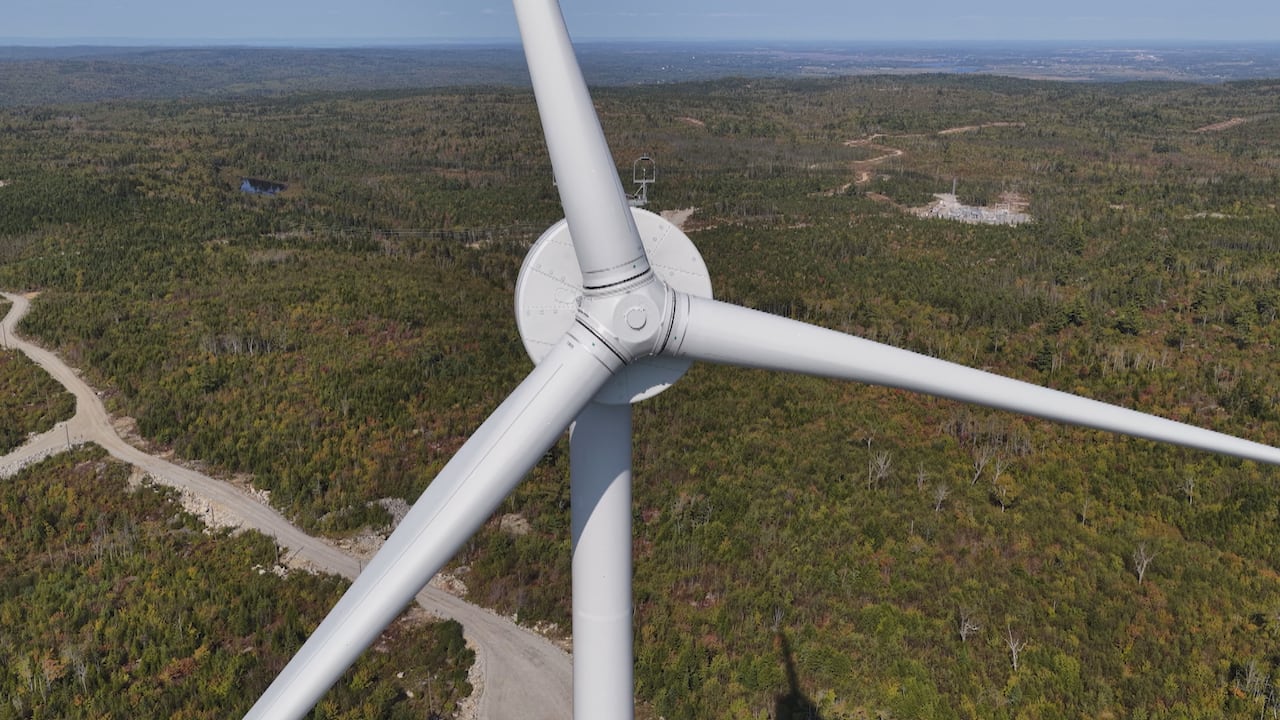
A turbine at the Benjamins Mill Wind Project in Hants County, N.S. (Brian MacKay/CBC)
Adair proposed 13 recommendations to enhance the environmental assessment process and the monitoring of compliance once a project receives approval. Her report indicated that the provincial Environment Department concurred with all of the suggestions.
“It is troubling to hear from government reviewers that they feel muzzled or are discouraged from voicing their concerns. This sentiment was a recurring theme during our investigation, which is very alarming,” Adair remarked at a news conference on Tuesday.
Environment Minister Tim Halman defended the province’s environmental approval process, stating in an emailed response on Tuesday that “decisions are made with thoroughness, based on scientific evidence and facts.”
While he did not directly respond to inquiries regarding the alleged silencing of government reviewers, he asserted that the reviewers carry out “invaluable and essential work” to ensure informed decision-making.
According to the auditor general’s report, Nova Scotia’s environmental assessment procedures are generally in line with those of other provinces.
Adair noted that several concerns raised in the current report had been previously identified during her office’s review of this process in 2017, and those issues had been addressed by the time of her follow-up in 2020.
However, she expressed that this is no longer the case.
“This audit indicates that there has been a regression or backtracking. I find this very concerning,” she stated.
Adair emphasized the necessity of effective environmental oversight, particularly as Nova Scotia relies on onshore wind energy to achieve its renewable energy objectives by 2030.
More than 300 commercial wind turbines are currently operational in Nova Scotia. By 2025, these turbines accounted for about 17 percent of the province’s total electricity generation. The wind farms are owned by Nova Scotia Power, community groups, and independent energy producers.
The auditor general pointed out that after a project is approved, the department fails to adequately monitor it to ensure compliance with terms intended to manage environmental risks.
Among the 13 recommendations in the report are suggestions to enhance environmental assessment terms and conditions by incorporating measurable criteria with clearly specified timelines, as well as requiring staff to document their reasoning when reviewer feedback is not integrated into the environmental assessment terms.
Additionally, Adair stated that the department must confirm the qualifications of external consultants involved in the assessments.
NDP member Lisa Lachance expressed on Tuesday that the audit raises serious concerns, highlighting that Nova Scotians cannot place their trust in the environmental assessment process.
“Experts, our public servants, are being prevented from effectively performing their roles. Their recommendations are being disregarded and silenced,” Lachance told reporters on Tuesday.
Lachance stated that Nova Scotians have valid worries regarding the impacts of energy project development on the province’s land, water, and wildlife.
“This government aims to hastily advance without building trust or conducting thorough due diligence. I believe the environment minister is not fulfilling his responsibilities when he neglects to adhere to a proper environmental assessment process,” Lachance remarked.
Interim Liberal Leader Iain Rankin stated that the absence of compliance monitoring undermines the entire system.
“The effectiveness of environmental assessments is directly tied to the quality of their enforcement,” he told reporters on Tuesday.
MORE TOP STORIES
-
Dartmouth councillor wants cleanup plan for discarded drug gear piling up at city parks
-
Settlement approved in N.S. First Nation class action over non-consensual MRI scans
-
Man accused of threatening N.S. chief medical officer and daughter agrees to peace bond
-
N.S. government to hold livestreamed information sessions about data centres
-
Halifax broadcaster Todd Veinotte dies at 57
Tag: rewrite-pending