


The union that represents General Motors employees has announced that its members have cast their votes favorably, overwhelmingly approving the new contracts with the automaker.
On August 22, Unifor and GM reached a provisional agreement concerning labor contracts for over 4,600 workers in Ontario, and union members participated in the voting process over the weekend.
In a news release issued on Sunday, the union stated that the three-year collective agreements would raise wages to $50.20 per hour for full-rate production workers and to $62.71 for skilled trades employees.
Members from Oshawa, St. Catharines, and Woodstock showed an 80.5 percent approval rate, while Ingersoll members supported the agreement with a 96.5 percent vote.
Discussions between the union and the automaker commenced earlier this month after Unifor finalized an agreement with Ford, and the union indicated that its contracts with GM reflect the same three-percent annual wage increases negotiated with Ford.
Lana Payne, Unifor National President, remarked that the agreements promise more than $1 billion in investments directed towards GM facilities in Canada.
“GM is investing in both its skilled Canadian workforce and facilities during a critical period, as our domestic auto sector faces challenges from the Trump Administration,” Payne stated in the union’s announcement.

Lana Payne is Unifor’s national president. (Justin Tang/The Canadian Press)
Jack Uppal, the president and managing director of GM Canada, commented that the ratification signifies that the company “achieved an outcome that benefits our employees, enhances our manufacturing capabilities, and establishes a strong foundation for GM’s future in Canada.”
Unifor noted that negotiations with GM were conducted under difficult conditions, as production at the CAMI Assembly Plant in Ingersoll was halted and most members from that plant were on indefinite layoff.
The union expressed its commitment to advocating for the resumption of production at CAMI Assembly. Furthermore, GM has designated it as the primary plant for any Canadian Armed Forces defense contracts awarded to GM.

Jack Uppal, centre left, president and managing director, GM Canada sits alongside representatives from GM as Unifor opened negotiations with General Motors back on Aug. 10, 2026 in Toronto. (Keito Newman/The Canadian Press)
Uppal stated that an additional investment of $144 million in Oshawa would facilitate the production of the next-generation GMC Sierra Heavy-Duty at the plant, complementing a previously announced investment of $343 million for next-generation truck production and manufacturing upgrades.
He added that a new investment of $215 million at St. Catharines Propulsion designates the plant as the exclusive source for a next-generation transmission. Together with a previously disclosed $691 million for sixth-generation V8 engine production, the total investment at St. Catharines surpasses $900 million.
“For our team at CAMI Assembly, we have extended layoff benefits to demonstrate our ongoing commitment to support employees while we evaluate potential opportunities for the site,” Uppal mentioned.

Trevor Longpre is Unifor’s General Motors bargaining committee chairperson. (Keito Newman/The Canadian Press)
Unifor also highlighted key aspects of the agreement, including the reinstatement of a cost-of-living allowance, a $10,000 bonus for productivity and quality for eligible members, and a $2,000 bonus in December for qualifying individuals.
Trevor Longpre, chairperson of Unifor’s General Motors bargaining committee, remarked that significant advancements were made in “securing stable and quality auto jobs and a stronger Canadian presence.”
“However, the effort to restore production at CAMI is ongoing. This agreement provides our Ingersoll members with a bridge until we can return CAMI workers to their jobs,” Longpre stated.
Agreement amidst trade war concerns
Canada’s automotive industry is facing 25 percent tariffs imposed by the U.S. on vehicles, with U.S. President Donald Trump pledging to increase this to 50 percent on January 1, 2027. The future of Canadian auto plants has become a critical topic in the stalled trade negotiations between the U.S. and Canada.
Trade discussions between the U.S. and Canada concluded last week due to unresolved matters, such as the potential reduction of tariffs on medium and heavy-duty vehicles, which are vital for Canadian manufacturing.
American auto manufacturers had anticipated that the trade negotiations would provide relief from the existing 25 percent tariffs, which have escalated shipping costs for vehicles and parts across the border.
According to Barclays research, approximately 17 percent of GM’s Chevrolet Silverado pickup truck production, which is the company’s best-selling model, occurs in Canada.
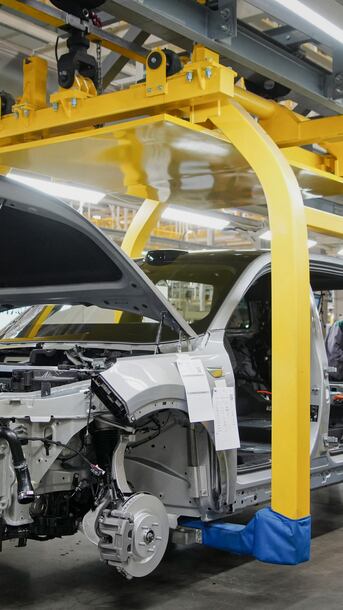
Car parts can cross international borders six, seven or even eight times before ending up in a vehicle. But amid a trade war, as both Canada and the United States raise tariffs up to 50 percent, it’s getting more expensive — and complicated — to build cars. The CBC’s Acton Clarkin breaks it down.
Tag: rewrite-pending