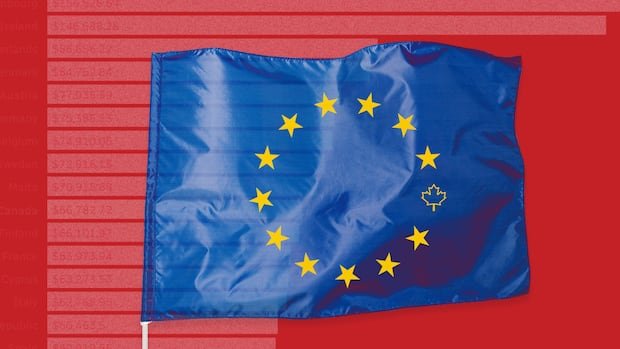


The European Union aims to have Canada as its first “associate member” among the 27-member bloc, as global trade diversifies beyond the United States. European Commission President Ursula von der Leyen emphasized the need for the EU and Canada to revamp their partnership beyond a basic free-trade agreement. Prime Minister Mark Carney expressed support for closer ties, highlighting Canada’s pursuit of resilience and sovereignty. He proposed enhanced integration in critical sectors like artificial intelligence, defense, energy, research, and finance.
While the concept of an “associate member” is not currently a formal designation, EU regulations typically limit membership applications to European nations. Nevertheless, Canada is poised to strengthen its trade connections with Europe, with economic comparisons showcasing Canada’s position relative to potential EU allies.
GDP per capita, a key indicator of economic wealth distribution, places Canada in a favorable position compared to EU countries like France, Italy, and Spain, but behind Germany. Despite holding a competitive stance, many EU nations fall below the OECD average, with countries like Australia and Iceland outperforming Canada.
In terms of inflation rates, Canada has maintained a stable two percent rate in 2025, lower than several EU members. Amid global challenges, Europe faces energy price escalations due to geopolitical tensions, leading to interest rate adjustments in the eurozone.
When examining the total debt-to-GDP ratio, Canada’s standing would be among the highest in the EU if it were a member, trailing behind France, Italy, and Greece. This debt level has drawn attention from the International Monetary Fund, which recommended prioritizing debt reduction in fiscal planning.
Canada’s existing trade relationship with the EU involves significant imports and exports, with Germany playing a pivotal role as a major trade partner. Notably, Canada imports machinery, vehicles, and pharmaceuticals from Germany, while exporting energy products, ore, and precious metals.
These comparisons underscore the potential benefits and challenges of deeper integration between Canada and the EU, paving the way for a more robust economic partnership.
[Source](https://www.cbc.ca/news/canada/eu-trade-economies-compare-charts-9.7346706)