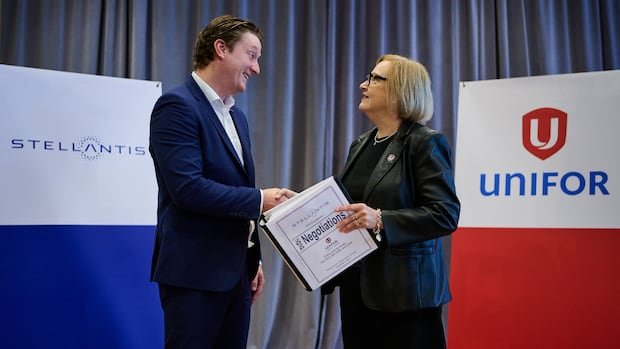


The labor union representing Stellantis workers cautioned the American automaker against undervaluing its Canadian workforce as contract negotiations with Unifor commenced on Tuesday. Unifor’s discussions with the Detroit Three automakers typically follow a pattern bargaining approach to establish terms for potential replication with other companies.
Unifor’s national president Lana Payne emphasized the upcoming negotiations as the union’s toughest challenge, despite recently finalizing agreements with Ford Motor Co. and General Motors in Canada. The focus of the ongoing talks, set to conclude by September 11, revolves around job security following the layoff of over 2,000 employees at Stellantis’ Brampton, Ont., assembly plant, which has been inactive since 2023.
Recent developments indicated a potential closure and sale of the Brampton facility by Stellantis, disrupting plans for Jeep production that commenced in early 2024 but were paused in early 2025. The decision to relocate Jeep Compass production to the U.S. was deemed a breach of the existing collective agreement by Unifor, resulting in the indefinite idling of the plant.
Stressing the importance of rectifying the situation, Payne reiterated the necessity of reinstating vehicle production at the Brampton plant and rebuilding trust with workers and Canadians. Stellantis acknowledged the significance of the labor negotiations for its future, recognizing the evolving trade and regulatory landscape impacting the industry.
The talks occur amid challenges posed by U.S. tariffs affecting local automakers, with the threat of increased tariffs by President Donald Trump adding pressure to the negotiations. Unifor emphasized the critical need for Canada to uphold its auto sector presence amidst the economic uncertainty, highlighting the potential ramifications of escalating tariffs on the North American auto industry.
Larry Savage, a labor studies professor, noted the dual battles Unifor faces in safeguarding production in Canada and advocating against trade agreements that could jeopardize the auto industry. The recent ratification of new contracts with General Motors by Unifor members underscores the ongoing efforts to secure favorable terms in the auto sector.
As Unifor continues its negotiations with Stellantis, the outcome will not only impact the Canadian auto industry but also set a precedent for future labor agreements and industry stability.