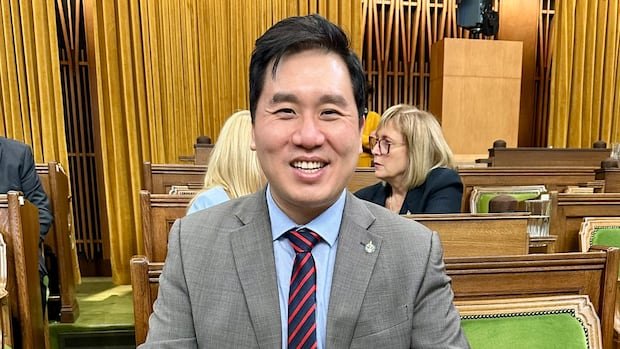


Liberal Member of Parliament (MP) Shaun Chen faced accusations online of violating House rules by casting votes while in China earlier this year after announcing his resignation from the House of Commons. The allegations, fueled by conservative influencers and some current and former Conservative MPs, were based on videos shared on the Chinese social media platform WeChat showing Chen’s visit to China.
One post from independent journalist Andy Lee highlighted a video of Chen enjoying ice cream on March 25 in China, the same date he allegedly voted six times electronically in the House of Commons. Concerns were raised about the potential breach of national security if Chen indeed voted remotely from China.
Conservative MP John Barlow echoed these concerns, emphasizing the seriousness of the situation and the need for answers. Barlow referenced House of Commons standing orders that explicitly prohibit MPs from voting while outside Canada.
The contentious issue revolved around Chen’s alleged participation in voting on Bill C-9, the government’s hate crime legislation, while he was in China. While acknowledging the possibility of edited videos, Lee maintained that the legitimacy of Chen’s voting location warranted scrutiny.
House rules dictate that MPs cannot vote from outside the country, with electronic votes permitted only within Canada. Visual confirmation of a member’s identity is required, utilizing facial recognition technology through a designated app for recording votes.
In response to the accusations, Chen’s office clarified that he was in China from March 14 to March 22, returning to Canada for the House of Commons session on March 23 after the spring recess. Supporting documentation included Chen’s boarding pass showing his return flight from Taipei to Toronto on March 22, as well as visa stamps in his passport indicating the travel dates.
Chen’s office emphasized that he did not vote from outside Canada and cited health reasons for his limited travel to Ottawa, leading to his decision to resign. The trip to China was described as official parliamentary business organized by the Canada-China Legislative Association, with cybersecurity precautions taken during Chen’s travel.
Questions were raised about Chen’s ability to travel to China despite health issues preventing frequent trips to Ottawa. The trip was sponsored by the Hakka Canadian Association, chaired by Markham Coun. Joe Li, with details disclosed by the Office of Canada’s Conflict of Interest and Ethics Commissioner.